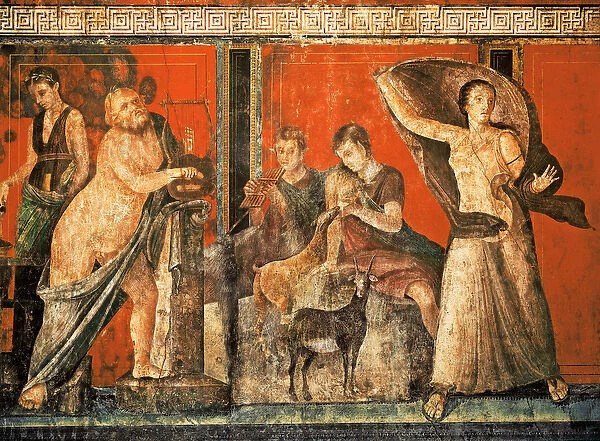
Norway, 11.06.2023
Written by Jon-Lennart Aasenden.
The role and purpose of religion in our modern age is undoubtedly a fundamental question. It’s understandable that many people have rejected religion or want no part in it, given that those who were supposed to represent religion have often made a mockery of it.
Ironically, the individuals least equipped to understand religious texts and ancient symbolism often claim to be the custodians of our spiritual heritage. It requires a certain level of megalomania to believe that sacred mysteries were meant to be broadcast on TV like a rock concert, hosted by multi-millionaire pastors who exemplify every form of vice and corruption known to man.
Modern religion’s refusal to consider that deeper and more profound esoteric knowledge might exist beneath the surface of these texts is another issue. The emphasis on historicity, whether in Christianity or other Abrahamic traditions, has indeed led to conflict, suffering, and what some might describe as a form of collective insanity.
So let us jump straight to the point.
The purpose of all true religion is the transformation and perfection of man. The salvation from a lower state of suffering and ignorance, onto a higher state of compassion, wisdom, insight and completeness. In other words we are not dealing with fleeting emotions of goodness or escapism through a fairy-tale here.
No, religion, true religion, has but a single function and that is the complete and radical transformation of human consciousness at the most fundamental levels of our being.
Religion is very clear about what the end results of such a process should be, which is where the typical savior figures come in. The hero of the narrative embody the end result of serious spiritual development, which in the west was a Jesus like figure that has complete control over his own nature; where lust, violence, anger and hate has been completely and utterly eradicated; replaced instead by a razor sharp intellect, deep and enduring empathy for all sentient beings, as well as demonstrating abilities that can only be categorized as supernatural.
“Unto a perfect man, unto the measure of the stature
Ephesians 4:13
of the fullness of Christ“
This radical, if not incredible transformation, takes place when the aspirant comes into contact with the divine forces both inside and outside of him; forces which are intrinsic to reality itself. The biggest shock is without a doubt when the aspirant discovers that the powers found in nature, these indescribable forces that carries all living things yet remains ever fresh through the process of mutation; that structures matter and cause formations of entire galaxies – is in fact the exact same force that flows through us.
It’s crucial to grasp that what I’m outlining here isn’t a mere illusion or wishful thinking. The aspirant doesn’t simply receive verbal instructions; they undergo a genuine and direct encounter with the divine. In Christian terminology, this might be summarized as receiving the Holy Spirit through baptism administered by a lineage holder. In Hindu and Buddhist contexts, it’s known as Shaktipat, a Sanskrit term often translated as “the forgiveness” or “touched by the spirit.”
As you probably have understood by now, the purpose of this transformation has never been to produce a brainwashed cult fanatic at odds with reality (which is the only result literalism can produce), but rather a reasonable, joyous, peaceful, wise and complete human being. This process is not detached from the laws of physics, but rather a monumental psychosomatic rewiring of our very core; with concrete steps that has to be followed in the exact order. If the aspirant deviates from the process once it has started, or is in fact not mature enough to handle the encounter, the results will not be as described above.
The dangerous, sinister, intense, and somewhat schizophrenic behavior often associated with cult followers in the West is a result of several factors. It can happen when the aspirant is misled, lacks a true understanding of the spiritual process, or convinces themselves that they have completed the great work and are now holier or justified, leading people to utter ruin.
This distorted mindset has led to numerous tragedies, including manipulation of the vulnerable, suicides, and even acts of murder. Unfortunately, the world has witnessed many such individuals who believe they are Jesus, or who abuse scripture through literal interpretation, causing unbelievable harm through their lack of symbolic understanding. They literally make it up as they go along.
These flaws in understanding and behavior are clear indications that something has gone terribly wrong, or the aspirant has a flawed perception of what true religion entails.
Genuine teachers and lineage holders, in whom the spirit truly resides, are rare to find. Exploring the material on one’s own can be a lifelong endeavor, even with comprehensive comparative analysis of our inherited esoteric traditions. Personally, I’ve dedicated approximately 30 years to this pursuit, and there are still unanswered questions. I’ve left no stone unturned, and while I’ve reaped intellectual and spiritual rewards, I acknowledge that I may be planting a tree whose shade I might never enjoy.
I’m writing these papers not for my own sake but for those who may follow this path after me. They may possess greater insight and capabilities, allowing them to fully reverse-engineer the path.
To help restore sanity into what was once a beautiful journey within.
Cult material
The reason spiritual evolution has gone terribly wrong in the west, is because the understanding of this transformative process, even the existence of the process itself, was lost at a very early stage. The Christian gospels have been sold as a purely literal and historical doctrine (at spear-point I might add). As such, a Christian must by definition believe that Christ was the only son of God, who was born of a human female virgin in the Jewish levant, who walked the land collecting 12 disciples, performing impossible tasks, before he was eventually betrayed, captured, tortured and killed. He then magically arose from the grave 3 days later – because he was actually God in disguise.
To make the narrative even more confusing, Christ is supposed to have taken human birth exclusively to suffer the worst possible death as atonement for his own anger over our sins. Especially the sin we somehow inherited from Adam and Eve who (in the narrative of the old testament) lived thousands of years prior to Christ, because they were tricked into eating a piece of fruit by a talking snake [sigh].
Like I said, I don’t blame people for rejecting such a narrative. The only reason people have accepted it at face value is because it comes with the weight of 2000 years of tradition behind it.
What people forget, pastors and ministers especially, is that the written material they regard as history, is in fact a series of esoteric cult documents or mysteries as the catholic church calls them (from the Greek word ‘musterion‘, meaning hidden thing, religious secret, veiled information, something confided only to the initiated). These are documents meant only to be read by trained initiates. The bible as a whole was not available to the public until after the protestant reformation. Before this it was reserved solely for clergy, royalty and the upper echelon of society. Even fewer still were chosen to be initiated into the esoteric aspects of said tradition.
Within deeper theological studies, the existence of a secret, esoteric doctrine behind the gospels is not even questioned any more, it is accepted by more or less every theologian worthy of his salt.
“But that there should be certain doctrines not made known to the multitude, which are revealed after the exoteric ones have been taught, is not a peculiarity of Christianity alone, but also of philosophic systems, in which certain truths are exoteric and others esoteric”
Church Father Origenes, Contra Celsum, Chapter 7
Most cults in the ancient world operated in this peculiar fashion, where they had public material (written or not) that was exclusively transmitted by the learned priesthood (less than 5% of the population could read or write after all). These documents were typically authored in a poetic, mythic and highly symbolic language meant to be recognizable enough for an initiate to understand, enticing enough for people to be drawn to – yet obscure enough to keep the uninitiated “riff raff” outside.
As researcher John Whitty at the University of Oxford notes in one of his papers on the subject:
It is a well-established fact that philosophical schools restricted the knowledge of certain texts, and this reservist approach was intrinsic to their philosophical and pedagogic systems
John Whitty, University of Oxford, Rethinking the Disciplina Arcani
Besides the public myths and stories the ancient cults also maintained a purely oral tradition, one that was taught exclusively to select aspirants after their oath was taken (read: baptism). A transmission of knowledge which explained the cult material and what the symbols and sometimes absurd stories actually meant.
There were likewise techniques and practices that was kept secret and never written down, which the aspirant was taught as he progressed through the stages of his transformation. In both Greece, Rome and Egypt it was punishable by death to expose the secrets of the mysteries and very few people were allowed to become initiates in the first place. Plato himself was made to wait for twenty years before he was accepted into the Egyptian mystery schools, where he would end up spending years in deep study and contemplation. This secret oral tradition has come to be known as the Disciplina Arcani or “the secret doctrine” (also translated as “secrets of the ancients” and “doctrine of the secrets” depending on author).
Such an attitude is shared by the author of the seventh letter the ancient world thought to be Plato’s, and in such a spirit – notes Porphyry – was a pact formed between the students of Ammonius Saccas to not consign to writing the things he had taught them
John Whitty, University of Oxford, Rethinking the Disciplina Arcani
What is lost on most people today is that this secret doctrine was never exclusive to Christianity, but rather universal and used by all religions. If you were initiated fully into one cult, you would have no problems navigating other cults – because the underlying body of teaching was more or less the same (philosophical differences notwithstanding).
To be blunt, the written material was organized to facilitate cult practices (read: transformative practices) and must by consequence be studied as such. What gave Christianity an edge over competing cults of it’s day, such as Mithra, Dionysus, Hercules, Persephone or Apollo to mention a few – was that Christianity welcomed everyone into the fold, not just the wealthy upper classes. The early church thus offered salvation and transformation to everyone, including slaves, merchants, soldiers and whomever wanted to enter the royal path and perfect themselves. This act of mercy was seen as outrageous in the eyes of the establishment, which I suspect is the real motivation behind the fierce persecution they were subjected to by the Roman state.
A cult that welcomed both rich and poor, illiterate and scholar, was a direct threat to the established order. The fact that Christianity refused to recognize the emperor as the incarnation of God, and thus pay homage to him in Roman temples, was likewise a direct violation of Roman law. Without going off on a tangent, the Pope would later adopt the title reserved for the emperor, as Pontifex Maximum, and demand the exact same veneration as the Roman emperors once did – so original Christianity appears to have been short lived.
Before we continue I want to clarify what I mean with a universal esoteric doctrine, one that was shared by all religions.
In short my claim is simple: that the myths and often strange tales found in sacred texts, the bible especially, contains a hidden doctrine that only a rare few were ever allowed to learn. A doctrine that had to do with the human body and it’s processes that, even today, is completely unknown to modern science. And perhaps worse, forgotten and outright rejected by the church – who was supposed to be it’s custodians.
I realize of course that such a statement, which essentially says that millions of people have read their holy books the wrong way, and believed in the wrong things for two thousand years -is not going to receive a warm welcome. My work will no doubt be hounded and dismissed as new-age nonsense by the faithful. Because if I am correct, the very foundation of their theology, what they believe it is to be a Christian so to speak, has been wrong.
This entire book is ultimately dedicated to backing up that explosive assertion.
But first, let’s get rid of some of the typical counter arguments.
Security through obscurity
The reason modern Christians are utterly oblivious to the true nature of the gospels, and consequently fail to recognize references to it’s esoteric core when they read them, is simply because they have nothing to compare with. If you know nothing about ancient sciences such as sacred anatomy, mantrayana (sacred chants which has a profound effect on our body and mind) and it’s associated symbolism – how would you recognize them?
Take something simple, like the symbol of salt.
Salt was used by more or less all the mystery traditions of the ancient world as a symbol, first and foremost as a sign of wisdom, but more importantly as a hint to a profound psychosomatic process that takes place in the lower abdomen as a result of celibacy and specific sacred chants. Chants that were never shared except with a select few.
So when Christ in the gospel of Matthew warns about ‘salt losing it’s potency‘1, and that those that follow him are ‘the salt of the world‘, he was not talking about table-salt or something as mundane as being useful to one another (which seems to be how most Christians interpret that phrase). Or perhaps Lot’s wife was turned into a pillar of salt to help season an otherwise boring dish of lamb? Salt as a signifier, the Donatio salis, was introduced for pre-baptismal practices as early as St. Augustine2. Yet the true meaning of it was never divulged or explained.
So to be blunt, if you have no knowledge of what the symbol of salt actually means, reading the gospels as literal, historical fact as people do, you will just gloss over the whole thing and think no more of it. Which is how it was designed.
“The mysteries of the faith are not to be divulged to all. It is requisite to hide in a mystery the wisdom spoken, which the Son of God taught”
St. Clement of Alexandria, The Stromata, chapter 12 (200 AD)
All cult material was protected by this type of security through obscurity, where the reader will only recognize what is actually there if they already have parts of the knowledge. This was the whole point of an oral tradition, to teach only those with the intellectual and emotional capacity to understand the science of transformation – and at the same time filter out those not yet ready for the task.
Myth in this respect is a perfect vehicle for knowledge, because only through effort and an open mind will the seeker be rewarded accordingly. And through pondering and seeking answers the mind and heart of the aspirant is tilled from wild and barren land into soil that is suitable for a rich harvest. Sadly myth can also ruin good men and be the source of utter madness when interpreted out of it’s original context.
Please understand that I am not writing this to be mean or arrogant, or to belittle the kindness and good work many pastors and priests do on a daily basis. Kindness and compassion is never wasted, that is my firm belief. And it is not their fault that we were never taught the inner secrets of the gospels, because the mistake that led to the purely literal and historical interpretation happened in the first centuries after Christianity was introduced. The diciplina arcani was taught by Christians up until the fourth century, but at that point the Roman state deemed it illegal to teach the secret doctrine. This is where the Roman state solidified their power and iron grip over the masses by taking control of their spiritual life.
In modern times the catholic church like to explain that the disciplina arcani was dissolved because it was ‘no longer needed’, and that the secret doctrine was in fact just the Eucharist in disguise (sigh). The real reason is far more sinister and deals with the fact that the original lineage holders and custodians of the true church, which was in Egypt not Rome, were subject to brutal persecution.
The Christianity of the first three centuries was nothing like the Christianity that would emerge after Rome put it’s full might behind it. In the first and second century there was a myriad of Christianity’s, not just the ones we know today. Most of the Christian lineages appeared to have been gnostic in varying degrees, and were for the most part purely initiatory in nature.
The so called ‘gnostic heresy’ was around for a long time, even after Rome solidified it’s power. For example, a group called The Cathars actually fought the church as late as the 14th century (!). This was the last remnant of original Christianity in the west. An echo of what Christianity used to be like before Rome eradicated it’s competition.
While I can only speculate, those that take the time to study the earliest centuries and the many forms of Christianity that flourished both in the west and east (especially in the east), usually arrive at the same conclusion as to why Rome so aggressively uprooted every remnant of the esoteric tradition. The diciplina arcani was no longer taught because the original teaching had become heresy and a direct threat to the Christianity designed and practiced by the roman state. The gospels had been refactored, the narratives altered to fit an ‘esoteric pattern’ – and all gospels that did not fit said pattern was ultimately outlawed and burned. If anyone was caught owning said gospels, they risked excommunication, prison or death.
One might ponder what these Gnostic’s knew that could illicit such a violent reaction from a priesthood of such relentless love and kindness.
Those that knew
Anyone who takes the time to read and study how the many ancient mystery traditions operated, and by consequence the early Christians, will quickly notice that there were inconsistencies among bishops and the clergy, radical differences even, about what exactly the secret doctrine was. What Plato in his time coined as Ipse Dixit.
To simplify things I have organized these into four categories:
- The average believer or initiate
- Lower class clergy and priests
- Bishops and doctors of the church
- The elect, a close circle that would morph into the papacy over time
The first group is for the most part oblivious to any such doctrine, so there is not much to say about that particular group. The second category, the clergy and priests, are those that would be on the lowest receiving end of any such esoteric knowledge – but they appear more occupied in petty quarrels regarding liturgical elements, restricting access to communion -which some of them seem to have imagined was a secret that had to be guarded from the uninitiated.
The third group is ultimately where any such doctrine would be common, but here too there are radical differences of opinion. Some seem to believe that knowledge of the trinity itself constitutes a secret insight, while others lament over Christians that openly divulge the rite of communion.
My conclusion is that the first two groups can be completely ignored. The trinity was never really a secret, neither was communion. The exact same communion had been known and practiced in other religions for centuries (e.g. cult of Mithras, cult of Dionysus), and the same can be said regarding the trinity (e.g. Osiris, Isis and Horus in Egypt – Jupiter, Venus and Sol in Rome).
What we are left with is a fourth group, a closed circle of perfecti as well as a substrata of bishops who wrote nothing for posterity, such as Cyril of Jerusalem, on what the secret doctrine actually was. Since they made little or no effort in stopping the preceding groups in their petty quarrels and absurd idiosyncrasies, it is reasonable to conclude that these things did not constitute the secret doctrine.
Cyril of Jerusalem keeps his [secret doctrine] entirely secret, commanding his listeners to “inscribe it upon your hearts” rather than risk its dissemination by writing it down
John Whitty, University of Oxford, Rethinking the Disciplina Arcani
The only peculiarity of this elusive, silent group, compared to other bishops and doctors of the church, appears to be their association with Gnosticism (gnostic, meaning, “those that know”, from the Greek ‘gnosis’, knowledge). In particular, a form of Christianity coming out of Alexandria, The Valentinians, which align more with St.Paul’s modus operandi than it does the synoptic gospels. But I use the term gnostic very loosely here. It is important to keep this in mind, because the esoteric doctrine I see the outlines of is not Gnosticism, at least not in any known form.
It is rather something much, much older and more elusive.
Rethinking the narrative without bias
The task of compiling the roman version of Christianity fell on the church father Eusebius of Caesarea, which was an advisor to emperor Constantine I. Constantine ordered the creation of 50 bibles, and this meant that Eusebius had to clean up the myriad of gospels that were in circulation (essentially continuing the work of Irenaeus), many of them from the gnostic school.
What criteria he used to determine which text was ‘inspired‘ and which texts were not, is ultimately unknown. But we do know that he ordered the burning of more or less every gospel that did not conform with whatever criteria he operated with.
We also know that he was of the same school that church father Origenes came from. A church father that preached both reincarnation, the importance of the esoteric and secret teachings of Jesus, initiation and perhaps more curious – the value of the classical pagan philosophy schools. Origenes view on this matter seems to have been that Christianity represented a form of culmination of the older traditions that rendered them mostly obsolete, and in his debates with learned pagans he emphasized that the Christian doctrine was a kind of ‘next step’ in the evolution of spirituality.
But it is here, in the work done by Eusebius, that I suspect the first error occurred. Namely that of the nature of Jesus. Earlier forms of Christianity made no secret that Jesus was a human being, but that through his tradition he had purified himself and emerged a fitting vessel for the holy spirit. It was through this transformative process that he gained the title Christ, and obtained union with God (e.g. ‘I and the father am one‘). This aligns with terms used by the first Christians such as ‘being Christed‘ – as in going through a transformative process.
That Christ is a title and not a name is something even St. Augustine attested:
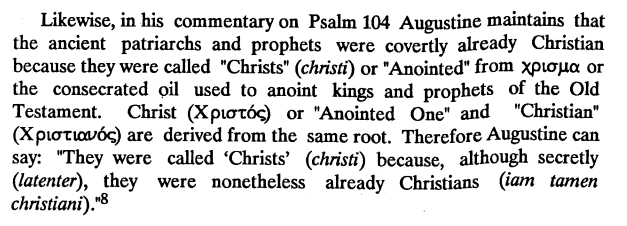
The way that these issues were interpreted by the early church is ultimately the problem, because they concluded something else entirely. The whole debate actually ended with the excommunication of Origenes, which was tortured and later died in exile from the injuries he sustained. Quite the reward for a man that had done so much to establish the faith.
Keeping these conflicting views in mind, let us try something completely new. Something never done before in any meaningful way: Let us go to India and look at parallels there.
If we go to India and look at the yogic traditions, you will find that they operate more or less like Jesus figures. Yogis have disciples, schools (ashrams as they are called) and by virtue of their spiritual practice they are known to gain spiritual powers (siddhis) and consequently perform miracles that defy physics. One of the first teachings of Indian spirituality, is that “God, guru and self is one and the same thing“. So Hindus practically venerate their gurus and saints while they are alive, because these saints are regarded as hosts (tabernacles) for the spirit of God. So veneration of a bonafide yogi, is to a Hindu the worship the holy spirit that he carries and have brought forth in himself.
A distinct part of being a yogi, is that the ego and personality of the individual becomes more or less transparent. A yogi is not an ordinary human being, but rather he has transformed himself into a vehicle for God. The will and whims of the person has been filed away through sadhana (practices) so that God and his light shines through him; which is why people respond to Yogis with such reverence.
Had Jesus been regarded as a normal human being that had radically transformed himself into a vessel, Christianity would not have the issues that have haunted it for 2000 years. And it would also have aligned western Christianity with some of the more esoteric doctrines of the eastern churches – and further, the mystery schools and established traditions of the yogis.
“When we say that the Word, who is the first-birth of God, was produced without sexual union, and that He, Jesus Christ, our Teacher, was crucified and died, and rose again, and ascended into heaven, we propound nothing different from what you believe regarding those whom you esteem sons of Jupiter“
Justin Martyr, Apology 21
The problem is that the west had no experience with the yogic sciences. So when the first general council was called for by Constantine in 325 AD, where they debated among other things the nature of Jesus – they made the spectacular blunder of defining him as ‘fully human and fully god‘ (a saying that align very closely with the idea of “God, Guru and self” in Hindu terminology). But this is where the idea of ‘Jesus as God in disguise‘ came from, which threw the proverbial wrench in the logic of atonement (known as ‘the ransom theory’ ) — of God murdering himself to appease his own wrath, due to sins we somehow inherited from two distant ancestors.
Had the church voted that Jesus was a human being that purified himself to the point where he became a vessel of God, the Christianity we would have inherited today would be very different. It would also include re-incarnation, gnosis (spontaneous and direct insight into knowledge without having read it) and a path compatible with the wealth of Hindu knowledge. People don’t know it, but there is a lot of Hinduism in the Gospels, as I will cover as we move forward on our journey.
At this point there really is just one question that begs an answer, namely which pattern this new Roman biblical narrative was organized around? What did Eusebius and those like him know that made them suitable to tell the difference between an ‘inspired gospel’ and a ‘fake’ or unsuitable gospel? And why would Rome even bother to hijack a relative small and obscure cult with so many confusing and competing narratives?
Who was this Jesus and what exactly was his religion?
A shift in perspective
Observant readers of the new-testament will notice that we actually have no idea what religion Jesus preached. If you suspend your cultural programming and what you have been told to believe and look at what the texts actually contain, the new-testament is ultimately just a story about a child born under miraculous circumstances to a Jewish family, who spent his childhood in Judea only to seek refuge in Egypt until he was a grown man.
On his return from Egypt he wanders around the Jewish landscape preaching compassion, warning of the errors of the established interpretation, the punishment of the wicked, forgiveness of sin – while collecting 12 disciples. The texts themselves contain no concrete doctrine or spiritual techniques at all. We quite frankly know nothing about his personal religious system beyond miracles, clever sayings and a persistent call for people to enter into a kingdom, a kingdom that is within each of us.
We can even argue that what he teaches is not Judaism, otherwise his teaching in the temple as a child would not have been alien to the priests and learned there3:
Everyone who heard him was amazed at his understanding and his answers, saying never have we heard a teaching such as this
New Testament, Luke 2.47
Christians will argue that he was Jewish and that he came to fulfill the law. But fulfilling a promise does not mean that you operate with the same understanding as the consensus. In fact, it makes more sense that the promise was not fulfilled prior to Jesus, because the sacred texts had been grossly misunderstood (which is persistently what his conflicts with the Jewish priesthood is all about).
But all of these inconsistencies and superficial contradictions resolve themselves once we understand the pattern I mentioned. A pattern I stumbled on while studying many religions and comparing their narratives – which restores what I call the first key to the mysteries.
Have you ever noticed how the heroes in various sacred stories seem to navigate in a way that have uncanny similarities? When you look at these journeys of saviors, the first thing that strikes you is that they appear too polished and systematic for ordinary human behavior. It is almost as if a pattern preexist the narrative – and a story has been spun around said pattern in order to make it appear historical and relevant.
Once we begin to look at how the various saviors move within the landscape of their respective narratives and compare them on what they have in common (as opposed to attributes which are unique), a pattern does indeed emerge. A pattern that exists more or less in every religion, hidden just beneath the text if you will, both in contemporary traditions and older, extinct traditions. When I write move, I literally mean how they navigate between cities or locations, people they interact with, the outcome of said interactions, miracles they perform and so fourth.
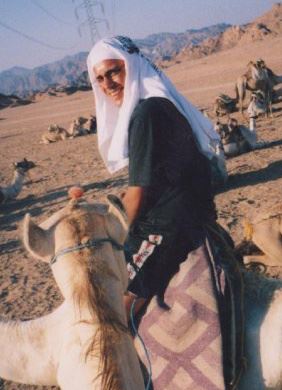
In my work I began testing my newfound observation by first comparing the actual maps of the regions where the narratives are set, with the literal story-lines as we have all been taught – and it quickly became clear that they don’t really fit. I have traveled quite extensively around the world, and know the region between Egypt and Israel quite well, and one of the first things you notice when you ride out to Sinai on camel or horseback – is that it would be technically impossible to wander around that desert for 40 years unless you kept going in a circle. It would be like saying that you wandered around central park in New York for 40 years without any influence from the city itself.
Once you get to Israel and look at places like Golgotha or the garden of Gethsemane, the abysmal scale of that place renders the idea of anyone being thrown off it’s cliff to their death utterly ridiculous. It’s barely a sloped hill, even if you take height for 2000 years of soil accumulation.
In short, the actual landscape on the ground simply does not fit the written narrative. This is made worse by the fact that Nazareth did not even exist, but seem to have been invented by the church.
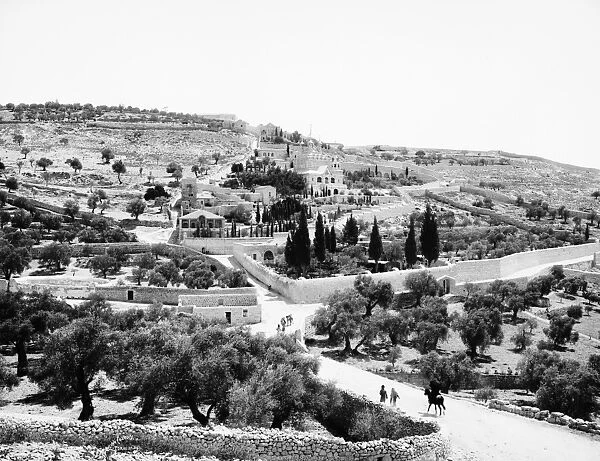
Let me summarize the problem with Nazareth as such:
- Nazareth is not mentioned in the entire Old Testament, not even once. The Book of Joshua (19.10-16) – in what it claims is the process of settlement by the tribe of Zebulon in the area – records twelve towns and six villages and yet omits any ‘Nazareth’ from its list.
- The Talmud, although it names 63 Galilean towns, knows nothing of Nazareth, nor does early rabbinic literature.
- St Paul knows nothing of Nazareth. Rabbi Solly’s epistles mention Jesus 221 times, Nazareth not at all.
- No ancient historian or geographer mentions Nazareth. It is first noted at the beginning of the 4th century
- The mother of emperor Constantine returned from her pilgrimage to the holy land, reporting that the inhabitants of Sepphoris had never even heard about Jesus. Yet she returned to Constantinople with a splinter of the one true cross (sigh).
- Close by to where the city is said to have been, we find the pagan city of Sepphoris which was established in the first century AD. Yet no mention of Nazareth has ever been discovered there, despite Sepphoris being just 45 minutes on foot up the road.
- The so called discovery of Nazareth was done purely by catholic priests (sigh). Between 1955 and 1960 excavations were conducted by Father Bellarmino Bagatti4, which represents a massive conflict of interest.
- The only thing Father Bellarmino Bagatti found on site, are ancient graves, most of them dating back to the early bronze age
The problem with finding just a handful of ancient graves with no infrastructure to speak of, is that Jews never buried people inside their cities or settlements. Graves were always outside — which means that the grave boxes Bellarmino claimed to be evidence for Nazareth, are in all likelihood graves from the Jews living in Sepphoris. Some archeologists even claimed that the location contained barely enough infrastructure to represent a single farm and family, let alone a village.
“The tombs, both those discovered by Bagatti and others known from earlier explorations, would have been placed outside the village and serve, in fact, to delimit its circumference for us. Looking at their locations on the plans drawn up by Bagatti (1.28) or Finegan (27), one realizes just how small the village actually was”
Crossan, The Historical Jesus.
I could continue, but I think you get my point.
Regarding the mother of Constantine which I list above, keep in mind that this emperor and his family were utterly ruthless individuals. Constantine had his own son killed based on fleeting rumors of a sexual relationship between his son and Faustia, Constantine’s wife. He later had Faustia executed as well — and ultimately killed his own mother by boiling her to death in oil (!). This is the man that would later preside over how the Christian faith was to be organized.
But with regards to Nazareth, this type of post-establishment of mythological locations is quite common for religions in what is known as land-shaping, where you adapt a region so it matches a mythology in order to live out your religion both mentally and physically. This was common for Egypt, India, Persia and even Greece.
So what possible landscape can fit I wondered? I can clearly see that the movement of these holy men in various religions have too much in common for this to be chance or a mere coincidence — but what can it possibly represent?
And it was here that it struck me. Jesus made it perfectly clear that the human body contains the kingdom of heaven. He also appeals to the people to “enter in” and repeatedly chastised the clergy of his day for preventing people from doing just that.
In John 2.21 when Jesus claims that he can rebuild the temple in three days, there is a curious detail towards the end:
But they did not understand that he was speaking about the body
New Testament [Norwegian translation], John 2.21
That line in combinations with the calls to “enter in” painted in my mind the contours of a spiritual landscape I knew from India. One that aligns the gospels with a universal esoteric concept, namely what is known in the east as the sacred body. Where the human body itself represents the landscape in which the narrative takes place; where the cities and people that our hero meets on his journey in reality represents the psychosomatic architecture of the human being; the internal wiring of our humanity if you will.
“The physiology of the ancients both among Greeks and Barbarians was a physical doctrine concealed in legends, for the most part a secret mysterious theology conveyed in enigmas and allegories”5
Collected works of Eusebius, Preparatio Evangelicum, ch 1, p. 2080, on Porphyry
In such texts, the cities are our organs and psychosomatic centers (e.g. nerve plexuses) and the roads are the nerve pathways (especially the 12 nerves inside the human spine).
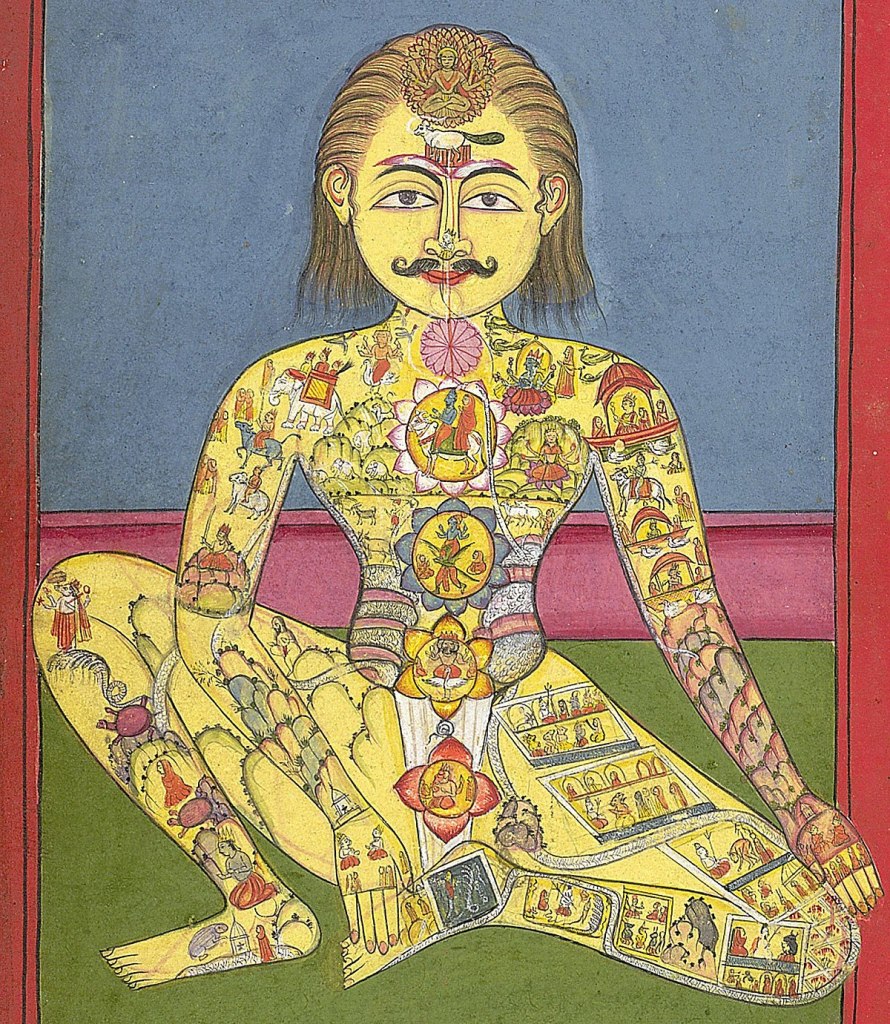
This way of organizing a mystery text, where you have an outer, exoteric narrative set in the present -which at the same time contains the esoteric doctrine, is consistent with more or less every initiatory religion in the world. Where you are gradually taught what the cities and social interactions really means as you progress through the ‘musterion‘.
And it just so happens that early Christian beliefs contains what is known as the sanctification of the body, which is achieved through a process called ‘a hypostatic union’. In other words, through celibacy, singing holy songs (mantra), faith and the indwelling of the holy spirit. Through such a process the body is transformed and returned to it’s original splendor (original here meaning, clean of vices and at it’s highest potential).
It is through this monastic process that Christian saints receive the gifts of the spirit, which are (for the lack of a better phrase) supernatural powers such as healing the sick, profound insight into things they cannot possibly know, and other saintly traits common to yogis and holy men.
Testing the map
With the first missing key recovered, namely that the landscape of the narrative actually represents the human body, all the strange and seemingly absurd contradictions in the texts that priests and their followers have argued over for millennia, murdered each other over even, automatically resolves themselves. The contradictions arise because people literally believe they are debating human beings and historical events, when the texts in fact describe psychosomatic principles and the aggregates of the human body.
When we take into consideration Paul’s journey into the third heaven, things begin to fall into place. What Paul is describing is the triloka, the three heavens of Saivism; the oldest divinity in human history.
I know a man in Christ about fourteen years ago (whether he was in the body I cannot tell, or whether he was out of the body I cannot tell, God knows) who was taken up into the third heaven. And I know the same man (whether in the body or out of the body I cannot tell, God knows), how he was taken up into Paradise and heard words not to be spoken, which no man can utter
New Testament, Corinthians 2.12
Before all the myriad of gods man has worshipped, there was Shiva. His doctrine goes so far back that it pre-dates all other religions in the world. He is Adi-deva, the first God that all other’s are but copies of. And his sign is the Triloka, the three horizontal lines that defines reality itself. He holds a trident, on who’s tip his three cities are said to sit. The trident being a symbol also of the human spine, with it’s tripartite division of the brain. The house of consciousness itself.

The emphasis on fourteen in the above section is what I call an esoteric marker. It acts as a hint to those that know what he is talking about. The human body contains 14 psychosomatic centers starting at the sole of the feet and all the way up to the scalp. Above those 14 centers are another 7 which are not available until the lower 7 centers have been utterly purified and sealed off (making a total of 21 major centers). So the animalistic or hellish centers are in the legs (which coincide with the 7 deadly sins), while the human 7 are from the groin to the human head (which coincide with the 7 virtues).
In Sanskrit the hellish, animalistic centers in the legs are called:
- Atala (upper thighs)
- Vitala
- Sutala
- Talatala
- Rasatala
- Mahatala
- Patala (sole of the foot)
Note: That last one, Patala, is where you have lost your humanity completely. In sacred anatomy the left sole of the foot is always marked with a black square, this is the Greek Tartaros where the Titans (raw forces of nature) is contained. If you have done every vice such as murder, rape, sadism and the like, you are effectively reborn in a hellscape reality from which there is no escape.
According to the yogic traditions of the east, our negative karma, or consequences of sin, accumulates in the legs. This is why it is common for yogis to wash the feet of their disciples, just like Jesus does in the gospels. This is done as a part of a purification ritual, in order to wipe the individual clean of past sins.
“Peter said to him, You shall never wash my feet. Jesus answered him, If I wash you not, you have no part with me”
John 13:8
Next we have the human and middle centers, which are named as such:
- Sahasrara (top of the head)
- Ajna (forehead)
- Vishuddha (throat)
- Anahata (heart)
- Manipura (solar plexus)
- Svadhisthana (beneath the navel)
- Mulhadhara (genital region)
These centers are not only psychosomatic centers in the body, but rather – they also represents your evolutionary level. The majority of human beings live in Mulhadhara, symbolized by a square. This is the common, ordinary modus operandi that most people live by where we are spellbound by the material world, our lives and the whims of sex, ego and social status. Mulhadhara is often referred to as ‘the foundation’ and ‘the rock’.
This is where we get to Saint Paul and his seven churches. I must admit that this was a very time consuming mystery to solve. Having to adjust my way of looking at the material from historic to esoteric was quite daunting, but in order to navigate these things we have to learn to see reality as people did thousands of years ago, there is no other way.
I literally had to reverse-engineer it through the ancient Greek system. If my thesis was correct, these seven churches Paul address with such fury, were in fact not historical, but rather a poetic and enigmatic description of the seven chakras (the human chakras from the genitals to the top of the head); which is the Sanskrit term for the main psychosomatic centers in the body.
So what I did was the following:
I looked up the presiding deity for each of the cities he mentions. Further I looked at their myths – and it immediately became clear that his accusation for each angel presiding over these 7 churches, are in fact references to the Greek gods presiding over those exact cities and their respective mythologies. It was here that I really started to dig into a deep study of the Hindu chakras, and discovered that the Greek myths actually describe the inner wiring inside each of these chakras. The fact that St. Paul outlines this, makes it statistically impossible that he was not familiar with these concepts.
When I checked the original Greek text where Paul goes to work on the seven churches, I found that the word used to describe “church” in these passages is ‘kirke‘ (which is familiar to Scandinavians since that is the word we use for church on a daily basis). Kirke is a Greek word that means “circle of power“, while the Sanskrit word chakra literally means “wheel of power”.
Mapping these to the seven churches was quite time consuming, but the results are as such:
- Ephesus
- Smyrna
- Pergamos
- Thyatira
- Sardis
- Philadelphia
- Laodicea
Saint Paul was in fact elaborating on the inner and most profound esoteric knowledge of the east, presented as letters to a set of abstract churches throughout the Greek world. But this also meant that knowledge of the Hindu esoteric system must be at the heart of Greek mythology. If my thesis was correct, I should be able to find the same principles at the center of Greek religion.
It was then that Homer’s Odyssey sprung to mind, and the classical tale of poor Odysseus as he struggles to return home to his wife on the island of Ithaka. His journey took him through seven masculine islands and seven feminine islands, each occupied by either monsters, god or goddesses (with twelve ships no less). It was no longer any doubt that my thesis was correct, and that I had accidentally stumbled upon an esoteric skeleton key, one that would unlock the past and shed new light on practically every ancient tradition.
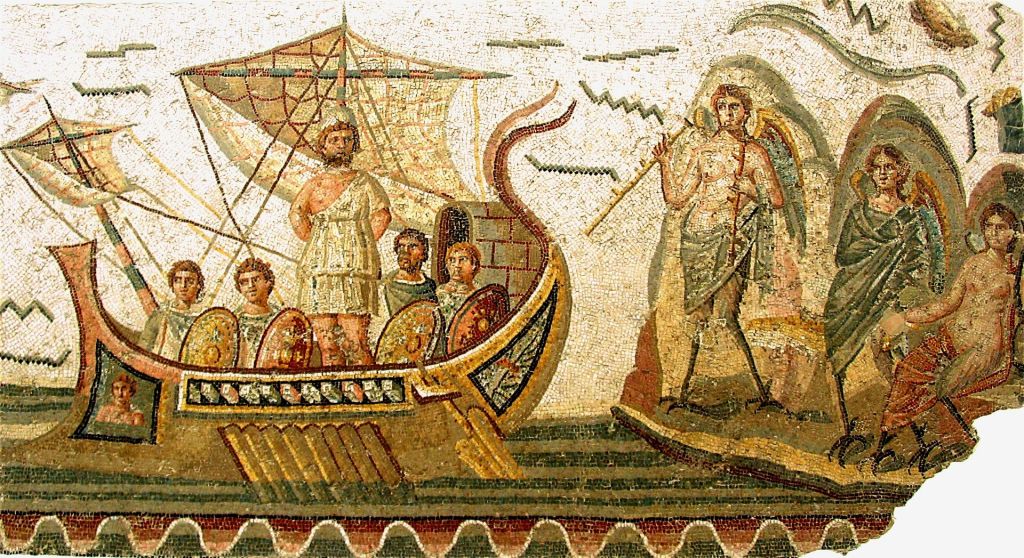
It also struck me that in the ancient Egyptian religion the Egyptian devil Seth conscripted the aid of 72 conspirators in murdering Osiris, who’s body was cut into 14 pieces. These pieces were “collected” by his wife, Isis to restore him. A similar motif can be found in Saivism, where Sati the first wife of lord Shiva dies, and in order to help Shiva with his grief lord Vishnu decides to cut her body into parts spread throughout India. Pilgrimage between these places to ritually ‘collect’ the pieces of Sati still takes place in India to this day.
As a note, I might also add that when Odysseus left the island of Ismaros, the first island he sailed to, he lost 72 men after raiding the place. In mythical terms one might say he took back what was once stolen.
The amount of correspondences that I accumulated as I dug into this material, are so many that my conclusions can hardly be dismissed as coincidental at this point.
“That which is called the Christian religion existed among the ancients, and never did not exist, from the beginning of the human race until Christ came in the flesh, at which time the true religion which already existed began to be called Christianity”
St. Augustine, memoir’s, ca year 400
The pattern I had stumbled on was a perfect fit.
Not only did it fit, it busted open the doors of more or less every extinct cult I could find. Christianity was not a new religion – it was the unification and synthesis of all the mystery cults. Apollo, Dionysus, Hercules, Mithras, Osiris – the entire collected esoteric knowledge of these cults was contained within the gospels. Or should I say, recovered, refactored and reintroduced to society after a long period of stagnation.
Most of these cults had fallen into obscurity, their myths no longer resonated with the public – and it was actually tradition in the ancient world to reinvent the outer clothing of the mysteries when the sun entered a new zodiac age 6. Christianity emerged just as we exited the age of Aries and ‘fell down’ to Pisces, the sign of the fish, which was the original symbol of Christianity to begin with.
Observant readers will realize that our sun is now leaving the constellation of Pisces and stand at the doorstep of Aquarius. If you pay attention you might notice that iconography of various religions have started to include the water pot. Sadly, the west and middle-east seem completely stuck in the mire of literalism, and are in my view doomed to vanish. Perhaps overdue considering the damage they have done over the centuries.
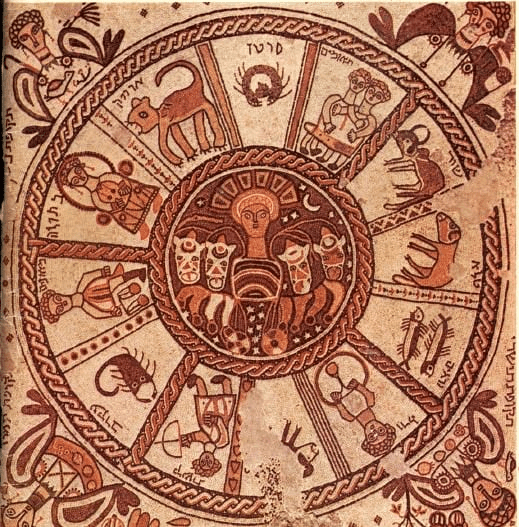
But there was no doubt where all this knowledge originated, and it was absolutely not Jewish, it was eastern through and through. The pattern I found works perfectly on the old testament as well, which means it predates it. I also discovered much, much more that sheds light on the pyramids at Giza, which has never been discovered before, that I will outline in another chapter.
I can only conclude that there really ever has existed one religion in the world, which has been adapted and re-shaped for relevance throughout countless ages. But with the loss of the great libraries, both in Egypt, Palmyra and Persia, just to mention a few that perished within a relatively short period of time leading up to the collapse of the ancient world -humanity quite frankly forgot our own history.
This eradication of knowledge, both practical, historic and religious, continued well into Islamic times. It is said that the Khalif of Kairo, continuously burned books from the great library of Alexandria for 40 years to warm his baths (!). The amount of knowledge the human race has lost is almost beyond belief. And it has rendered us easy pray for the psychopaths of this world; not to mention our own animal urges and instincts that we were supposed to tame and master.
The journey begins
With this key in place, the “entering in” that Jesus persistently calls for became vividly clearer to me. But sadly, I also recognized how utterly mishandled and abused true Christianity is. The loss of the disciplina arcani and it’s profound knowledge have, for the lack of a better phrase, castrated the mysteries and blocked people from experiencing the divine. Access to the divine was capitalized on by the church and restricted only to those that submitted to their whims and wishes.
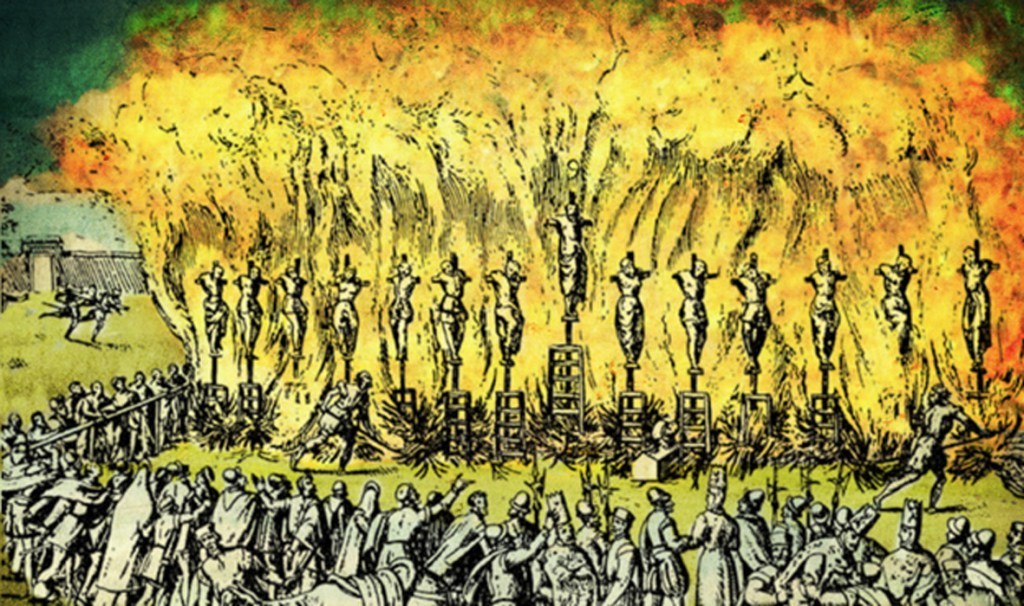
This will be a bitter sweet journey for the reader indeed, and for me personally I found it impossible to return to the church. My disgust for the history of that organization and the systematic crimes they have committed in the name of God, has for me become irreconcilable with even the most basic of morality.
But at least I found the first key. Now, let me show you what doors it opened.

