Before we proceed on our mystical journey, it’s essential to set some boundaries. After my initial discovery, I’ve been exclusively working within a framework that can only be described as yogic in nature. This means I haven’t let any ideas conflicting with what the ancient cultures themselves have to say about the subject, whether directly or indirectly, influence my perspective.
I use the term “yogic” here for practical reasons because the yogis of India and Tibet are the only cultures that have preserved and continue to practice the ancient science of transformation. Quite openly I might add.
These boundaries are incredibly important because interpreting any esoteric material, whether it’s visual symbolism or descriptive symbolism, demands an extensive amount of study to arrive at accurate conclusions. It’s all too easy to veer off course and get lost in what Buddhists call ‘the dharma of a thousand doctrines,’ essentially a metaphor for a wild goose chase. I’ll even go as far as to say that some texts from the ancient world are virtually impenetrable without a bonafide guru guiding you through them. It’s challenging enough to decipher esoteric subjects removed from their original cultural context by 2000 years, but it becomes nearly impossible to make sense of intricate, veiled knowledge without a certified guide.
Our problem in the West is that we have no such guides. The church conveniently persecuted them to extinction to solidify their own power. What we’re left with is a tangled web of symbols, clues, and fragments, which is a truly bewildering puzzle to untangle. The fact that those who claim to be the custodians of this knowledge consistently block and deny the universality of the esoteric knowledge found in the texts -has only served to make the situation even more challenging.
Every statement in this book stems from my diligent pursuit of every thread, striving to follow each one to its ultimate destination. I consistently approach the same symbolism from multiple perspectives and meticulously reflect on their validity. It’s incredibly easy to follow the wrong intellectual path and find oneself at a metaphorically dead end.
In this work, your sole tools are knowledge, determination, and intuition; with an emphasis on the latter.
After decades of dedicated study, of relentless trial and error, I’ve observed an unmistakable, recurring pattern: every time I successfully unravel such a thread, it consistently aligns with the yogic tradition. Over time, I have concluded that the hidden doctrine at the core of Christianity, or indeed any ancient religion that endures, derives from the ancient yogic schools. The manner in which yogis view and navigate reality appears strikingly similar to the practices of ancient cultures such as Egypt, Greece, Babylon, Rome, and so on. I feel my conclusion is reasonable and fair, considering the material I have managed to decode.
Let’s concretize what we have discovered so far:
- A secret doctrine of transformation exist, and is of unknown antiquity and origin
- This doctrine, universal in nature, was known and practiced by all the ancient civilizations in one form or another
- Central to the doctrine is the chakra model
- Earlier versions often operated with five chakras as oppose to the seven chakra model we know today. Tibetan Buddhism still operate with five major chakras.
- The inner ‘architecture’ and temple in the human being is often referred to with different terminology, such as:
- The sacred body
- The light body
- The Sah (Egyptian for spiritual body, as opposed to Ka, the physical body)
- The yogic body
- The church
- Chakras as distinct psychosomatic plexuses have been referred to differently depending on the culture, timeframe and tradition:
- The planets
- The islands
- The farmsteads
- The seals
- The oil lamps
- The circles of power [Greek: Kirke]
- The doctrine was (and is) largely initiatory in nature, with parts that should be kept secret (or in confidence at least), and parts that can be debated openly
- The concept of purification and forgiveness (which are closely connected) is central to the doctrine
To say that I was astonished to find that the only landscape that fits the biblical landscape, is in fact the human body, would be an understatement. Like most Scandinavians born in the early 1970s I was raised within a predominantly Christian cultural context and, for the most part, held a mental separation between our Western tradition and those of the East.
I would assume that this kind of mental division is a common experience for most people, regardless of the religious tradition they are born into. We tend to regard the traditions of our birth as somewhat distinct or closer to our hearts than others. However, with my discovery, this dividing veil disintegrated, and I gained the ability to scrutinize the texts from an analytical perspective. Prior to that pivotal moment, the Bible and its contents remained a blind spot in my understanding. I had an intuitive sense that something was wrong in how we interpreted these texts, but until that crucial juncture, I had been unable to engage these texts in a meaningful manner.
With my worldview suddenly flipped upside down, I had no other option but to follow through. And It has turned out to be, at least from my perspective, the most thrilling journey I’ve ever embarked upon.
A mystery in stone
The subsequent phase of my quest involved acquainting myself with the designs of ancient temples and early Christian churches. If, as I had discovered, the human body served as the blueprint for ancient mysteries, then similar notions should also be manifest in the architecture of temples and the early churches.
“In Egypt, India as well as later the Christian cathedrals of the gothic period, the temple was a book reveling an esoteric teaching”
The temple in man, R.A Schwaller De Lubics
From my earlier studies in the Catholic Church as a young man, I was aware that older cathedrals of Europe were initially designed to resemble the human body 1, with the church spire symbolically representing an erect penis. At the time, I had dismissed this as a mere overlap or ‘compromise’ with pagan beliefs. However, as I reflected on it in light of my discovery, it became increasingly clear that this was not a compromise but a deliberate choice. It was not a concession but rather a continuation of an underlying doctrine.
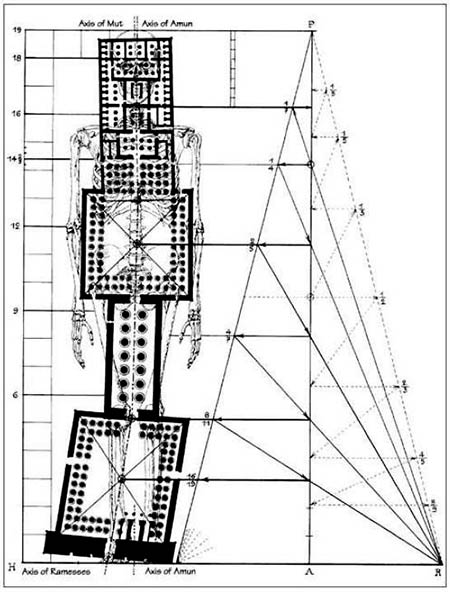
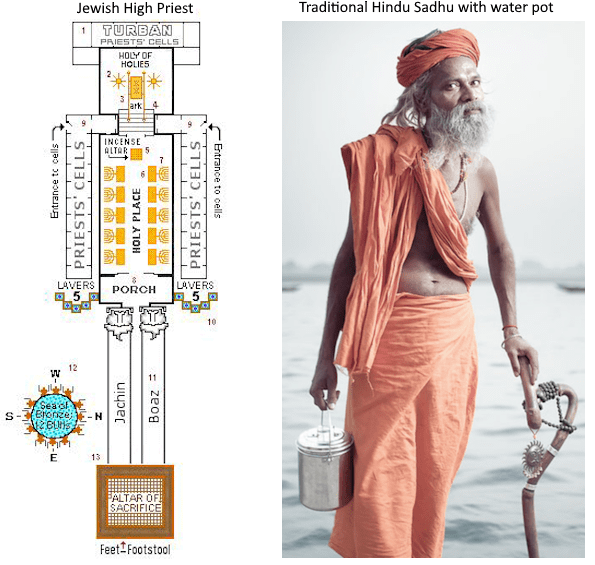
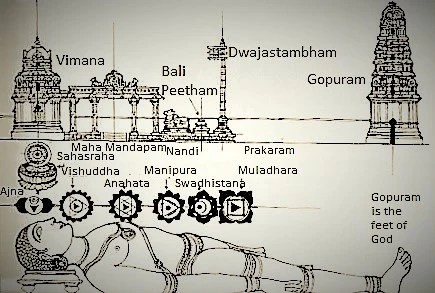
It didn’t take long for me to realize that the same principle held true for other religions, whether they are now extinct or still thriving. The temples of Egypt and Solomon for instance, were both designed in accordance with an idealized male form, and the same can be observed in Hindu temples.
The ribbed vaults of cathedrals mimic the spinal cord and ribs of a human figure
Peter Fingesten, Journal of Aesthetics and Criticism 3
I’ve personally visited the temple in Luxor, Egypt, on multiple occasions and have discovered so many parallels that attributing them to mere chance or coincidence would be utterly absurd at this stage. It appears that all the ancient cultures operated with a shared esoteric foundation, irrespective of the surface-level religions they embraced.
It was during my first visit to the Luxor Temple that I first came to the realization that the signs of the zodiac were not merely astrological signs, but actually medical signs. Each zodiac sign was associated with one or more specific region of the body. As outlined in the Pseudo-Hippocrates’ Treatise on Zodiacal Influence4
The body was divided into twelve houses, and since there are twelve zodiac signs, each one together with the influence of the seven planets played a crucial role ruling the different parts of human body.
Pseudo-Hippocrates’ Treatise on Zodiacal Influence4
However, as I explored the Luxor Temple, it became evident that much of the wall adornment wasn’t just memorandums of historical battles mixed with mythological narratives. Instead, they depicted the interactions of various forces residing within those particular body regions. For instance, if you entered a room representing the liver, the walls would be adorned with depictions of deities operating within the liver and their interactions. Most people don’t grasp what they are looking at because of the mythological medium.
Where academia just saw zodiac signs as medical symbols of an ancient, pseudo-scientific medicine debunked centuries ago — I saw that these signs were keys that could unlock the mystical secrets of ancient cults. It had never occured to academia, that ancient cults were tantric and psycosomatic in nature -and that zodiac signs in temples and sacred texts, literally availed the body parts involved in the transformative work that the ancients held in such high regard.
What if these zodiac symbols held information about biological functions we know nothing about? Secrets of the body that modern medicine has yet to discover. Modern doctors gasp when they see old yogis walk around naked in the freezing cold of the Himalayas, unharmed and unaffected by the deadly cold. Yet the mantra of modern medical professionals continues to be, that the human body contains no secrets. That we have nothing to learn and that all is known.
I think we have lost something. Something profound and important.
Sentient beings
The Egyptian concept of deity, known as “neter” (plural: “neteru”), is quite distinct from our contemporary notion of a singular God. They are perhaps better understood if we view the world through the lens of what Buddhists refer to as ‘Buddha nature’ and the primordial undefiled mind, which is perhaps best expressed as the innate intelligence of the cosmos.
In Mahayana Buddhist thought consciousness is ultimately an intrinsic part of reality, just like matter with it’s many elements and formations. Out of this endless substrata of consciousness all sentient beings arise in a myriad of configurations and based on an equal multitude of conditions. In this philosophy, which is ultimately a branch of Indian, predominantly Saivite doctrine, all living beings are born and reborn according to their behavior.
In this line of thinking, a human being or indeed, a deity, are ultimately just a ‘configuration of consciousness‘.
Buddha nature thus manifests in every part of our body, in every cell and organ – which autonomously manages the body’s functions. Your conscious mind isn’t directly involved in processes like digestion, blood purification, or oxygen supply to cells. Every cell in the body possesses a piece of self-awareness and collaborates to maintain the organism.
When we view the body as a conglomerate of consciousness, as a city of different configurations working together, it’s more easy to understand spiritual motifs that use composite glyphs to express ideas.
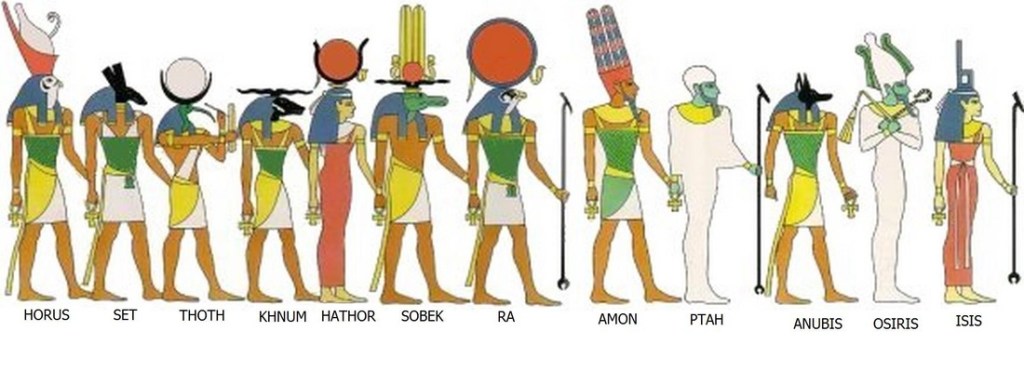
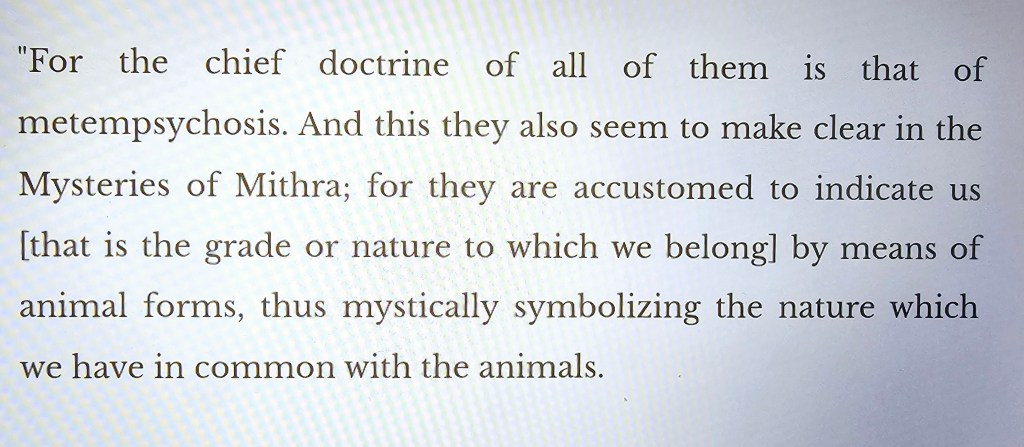
Mythological creatures, not just in ancient Egypt, are usually composites. They can have the mouth of a crocodile, the face of a lion, the feet of a hippopotamus and so on; each part was synonymous with the intelligence (and ferocity) those animals embody. The hybrid nature of deities was ultimately a way of describing the behavior and attributes of a deity – and further it’s function in the natural world.
I have come to call such hybrids as ‘functional types‘, in that each animal symbolizes a concrete intelligence, a conditioned consciousness, working within the ecosystem of nature. Mankind was regarded as the crowning achievement of nature, because in man all the functional types were invested.
The buddha touches on similar ideas in the Chachakkasutta, where he meticulously organize the human composition into six categories of consciousness that arises with a human incarnation. Each category containing six explicitly defined functions. I am not saying that these are the same as the Egyptian deities, absolutely not, but rather that ‘the view’ of the body holds some interesting synergies.
.. Dependent on the eye and forms, eye-consciousness arises; dependent on the ear and sounds, ear-consciousness arises; dependent on the nose and odours, nose-consciousness arises; dependent on the tongue and flavours, tongue-consciousness arises; dependent on the body and tangibles, body-consciousness arises; dependent on the mind and mind-objects, mind-consciousness arises ..
The Buddha, ChaChakka sutra5
So in Mahayana Buddhist philosophy, the body is seen as such an amalgamation of individual, smaller units of consciousness doing what they do (akin to the allegory of The Metropolis of Platonic thought). It is from this view that the Buddhist concept of ‘no fixed self’ emerges as obvious. This means that there isn’t a single organ that houses ‘you.’ If such an unchanging organ existed within us, it would render human growth and development impossible.
In Buddhist thought, and Saivism I should add, humanity is not alone. Out of the great ocean of consciousness comes a multitude of life-forms, some material and some more subtle in nature. Nagas, which are serpent like creatures of immense intelligence and power, are one species that is known — as are Gods of various power and influence (including the evil ones). These occupy the same space as us, but exist on a parallel plane – but they have the ability to enter our reality under certain conditions. These beings cannot be seen with physical eyes, they can only be felt in our bodies and sensed by our minds.
I have experienced this myself and can attest to the validity of this. They do actually exist, which came as a monumental shock to me when I had the grace to meet one. They have for the most part left us alone due to our ignorance and tendencies for violence.
Buddhism and Saivism
It’s important to note that this manner of ‘yogic thinking‘ or ‘viewing reality‘ is primarily tantric in nature. Tibetan Buddhism is, by its very definition, a tantric religion6 as it discards the anthropomorphic and mythological layers of Vedic thought and ritual, concentrating solely on the aspect of consciousness. This perspective operates with phrases like ‘sentient beings,’ which considers humans, spirits, and gods as distinct species caught in the same trap rather than positioning humans as subjects or servants to various entities.
To put it plainly, Buddhism can be viewed as a type of Saivism, which builds on the technical, esoteric understanding of Shiva and Shakti, as consciousness and energy. However, Buddhism does not incorporate the mythological aspects associated with Saivism and has evolved it’s own separate framework. Tibetan Buddhism is perhaps best regarded as an offshoot of Saivism, picking up where Saivism leaves off, so to speak. They have even retained Bhairava and Bhairavi, forms of Shiva and Shakti as patrons of their path.
Interestingly, the Dalai Lama participates in the Kumbh-mela gathering every 12 years in India (the time it takes Jupiter to complete it’s circuit around the sun). This event is the sole occasion when all yogic lineages come together for a grand festival. Yogis who typically live in seclusion in forests and avoid cities and crowds emerge to provide services to the public. During the mela, mass initiations take place, and new candidates join the path of yogis to embark on the journey of self-realization.
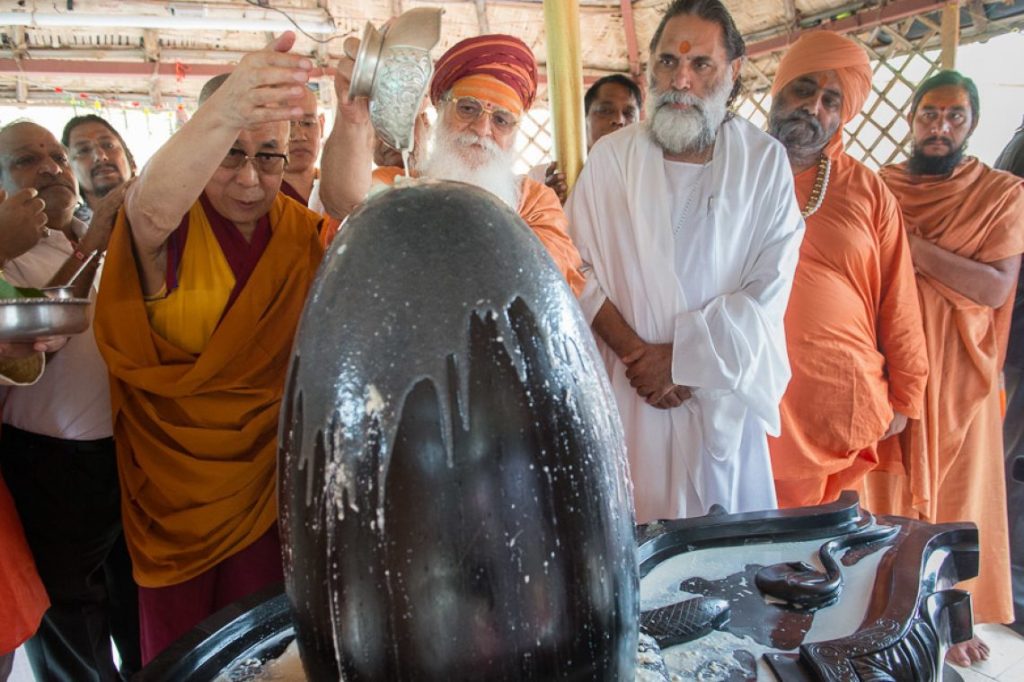
Here taking part in the worship of the Shiva Lingam. Source: DalaiLama.com
Buddhism has a funny play on words: Asserting that humans have no-self is essentially the exact same as declaring that God is the innermost core of our being. If God forms the foundation in each of us, the divine spark within, then what exactly defines and distinguishes your uniqueness? Where does God’s presence end, and where does your individuality begin? In many Hindu traditions, the ultimate aim is to achieve oneness with God. However, what many westerners fail to comprehend is that such a union would inevitably dissolve your individuality.
Thoughts immediately go to the gospel of John:
I and the Father are one
Gospel according to John 10:30
We see the same idea expressed in the gospel of Matthew:
For whoever wants to save their life will lose it, but whoever loses their life for me will find it.
Matthew 16:25
The rationale behind Buddhism discarding traditional mythologies becomes evident when viewed from a cultural standpoint. Religions that adhere to fixed mythologies, where deities are anthropomorphized as human-like beings with individual preferences, likes, and dislikes, come with a significant risk. The moment the underlying knowledge of what the mythology truly means is lost – its esoteric understanding and significance, if you will – what remains is a form of tribalism which ego thrives on. If you venerate a symbol while understanding it’s just a symbol, that is beneficial. However, if you worship a stone while believing that the stone itself is the deity rather than a vessel or representation, that becomes ‘adharma’, a departure from true religion. This deviation often serves as the breeding ground for fanaticism, exclusivity, oppression, and suffering.
Although I can only offer my own interpretation, my understanding of the story of Buddha is that he grasped this concept all too well. During his lifetime, India was undergoing significant social transformations driven by conflicts and widespread religious corruption. Many traditions had the population ensnared in a psychological stranglehold, resulting in immeasurable suffering and despair. People were trapped within a mental prison of myth, tradition and conflict.
The Buddha decided, in my view, that the best approach was to wipe the slate clean and start from scratch.
Again I want to clarify that I’m not suggesting that the ancient Egyptian religion resembles Tibetan Buddhism. What I am saying is that there are noteworthy similarities in how these traditions perceived reality and the inherent forces within it. Both traditions seem to be grounded in the same fundamental, timeless insight, which is what I categorize as ‘the disciplina arcani’ – the secret teaching of the ancients.
And indeed, it didn’t require much investigation to discover that the Buddha himself affirms this legacy7:
I found an ancient path, the ancient road traveled by the fully awakened ones of the past. And what is that ancient path, that ancient road? It is the noble eightfold path
Gautama Buddha, Nagara Sutta, The city
Further synchronicity
Speaking of an eightfold path, which is a definition that is unique to Buddhism I might add -it might be intriguing for people to learn that inside the human cranium there are 8 major nerve pathways (nadis). Normally, these aren’t readily noticeable, but they become more tangible when Kundalini awakening occurs. Another noteworthy observation is that when Christians took control of Rome, one of their first acts was to claim the Pantheon, a temple symbolically representing the head of the Roman sacred body. The Pantheon is a dome-shaped pagan temple where eight specific gods of the Greco-Roman system was continuously venerated. These eight gods were eventually replaced by Christian saints—saints whose myths can be seen as a refactoring of the deities they replaced; essentially Christianizing the deities as human beings and followers of Christ.
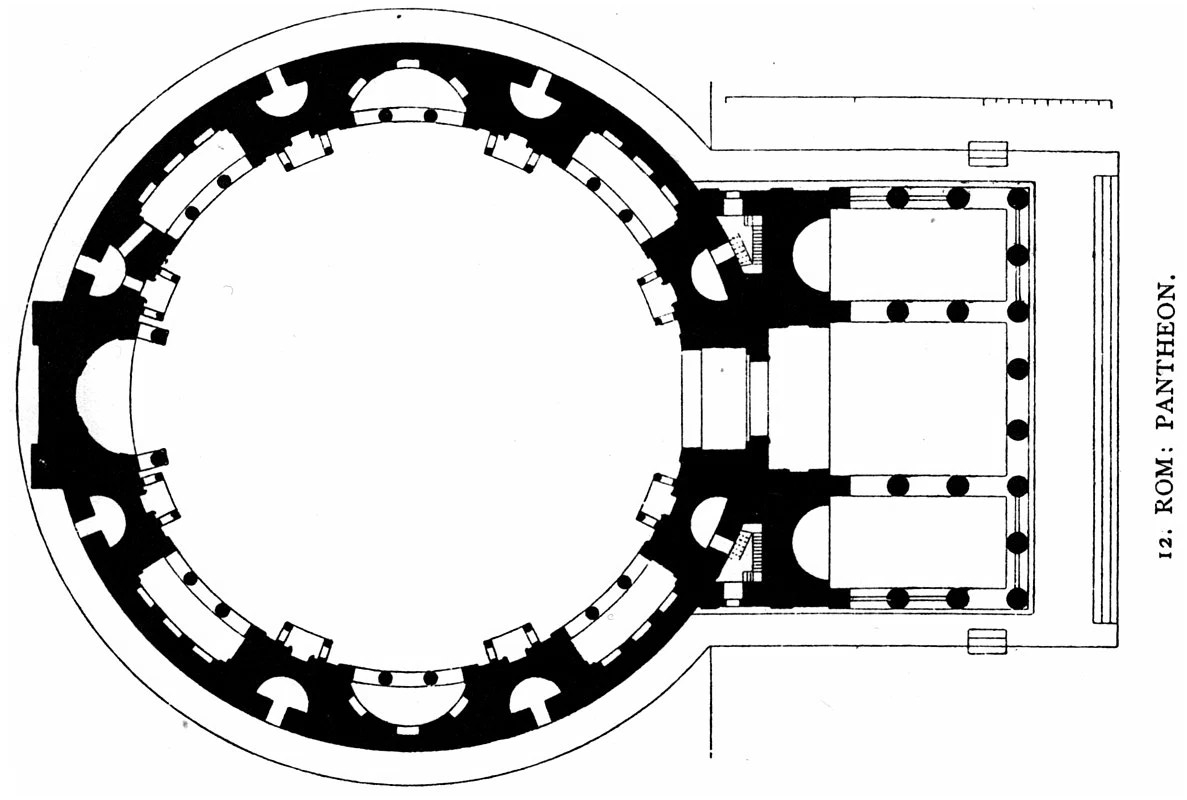
The precise sequence of gods that originally occupied the Pantheon temple is regrettably lost to the depths of history. Numerous speculations and efforts have been made to reconstruct which deities were there and in what order, with the aim of establishing a connection between paganism and Christianity. However, most of these attempts have, at best, been speculative.
I can also mention that there is a Hindu myth regarding the establishment of the 8 Mahajyotirlingams, which was given to a rishi called Gautama by Shiva to act as a proxy for the influx of the Ganges 9. The myth places these eight lingas at the foot of mount Kailash, which is associated with the human head. So eight powers associated with the head already existed in the framework of Savism. This myth only have two correspondences so I wont call it a direct match, but at least it avails that this knowledge did exist in the Saivist framework prior to Buddhism.
At this point I want to stress that I’m not suggesting that Buddhism is rooted in Greco-Roman mysticism either. What I am asserting is that the underlying esoteric understanding that that these traditions exhibit, like branches on the same tree, appears to be rooted in the same perennial wisdom tradition, a tradition that we know nothing about. There seemingly exists (or existed) a corpus of knowledge from which all religions, regardless of cultural distinctions or historical periods, seem to draw from.
To put it another way: there are numerous types of cars and vehicles in the world, but none of them would exist without a sophisticated grasp of metallurgy, mathematics, and precision engineering (along with the infrastructure to create such technology). I’m referring to this understanding of engineering, of how to build a car, and the inner workings of the vehicle – which is not the same as knowing how to drive.
The spiritual predicament of the west, to continue the parallel, is that we have inherited such a vehicle, but it only comes with a stock user manual and no demand for a driver’s license. We simply have no clue what’s under the hood, or how the engine and electrical system works.
We need to figure this out ourselves. Which is why a return to the perennial wisdom traditions is a priority.
If we return to the topic of Egypt, the ancient Egyptians were celebrated by the Romans and Greeks for their profound wisdom and deep understanding of the nature of reality. They have left us with insightful statements like this one:
The physical world is but frozen music
Ancient Egyptian proverb
A saying like this, in light of what I have already outlined, would be inconceivable without a profound understanding of matter and energy. By its very nature, such a statement encompasses knowledge of the behavior of sound (which they evidently mastered, considering the precision and resonance in their temples that endures to this day), as well as the comprehension of energy (Shakti), which serves as the foundation of mantrayana (the practice of chanting specific sounds and words that influence the body, mind, and ultimately the surrounding reality). One simply cannot perceive matter as ‘frozen music’ (read: fixed energy) without the direct application of specific disciplines and expertise.
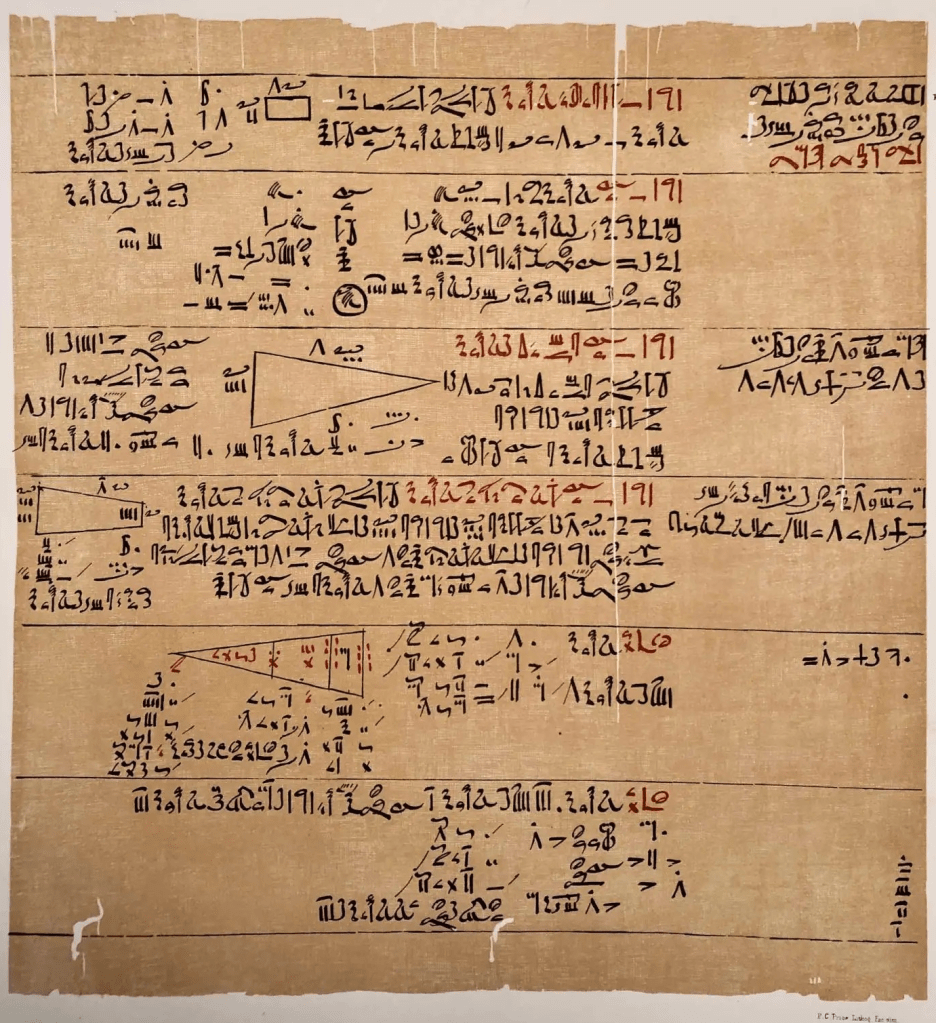
When we reflect upon the fact that we struggle to handle the stone blocks that the Egyptians appear to have manipulated with ease, some of which weigh as much as fifty metric tons, I believe there is reason to regard their legacy with some respect.
The Egyptian nativity
Born under the sign of Virgo, associated with curiosity, knowledge, and attention to detail, it felt natural for me to explore the area corresponding to my own sign in the Luxor Temple. This specific location lies slightly above the solar plexus, between the heart and solar plexus, representing the domain of the mother goddess, often symbolized as the vagina (yoni) or ‘womb of the virgin’ (known as kumarigarbha10 in Hinduism; Da’at11 in Jewish mysticism).
What I encountered there was truly fascinating. I discovered a mural dedicated to Amun, the highest God in the Theban religious system, engaging in a conversation with Meri, informing her that she would give birth to a child. What I stumbled upon was nothing short of a precursor to the Christian nativity scene.
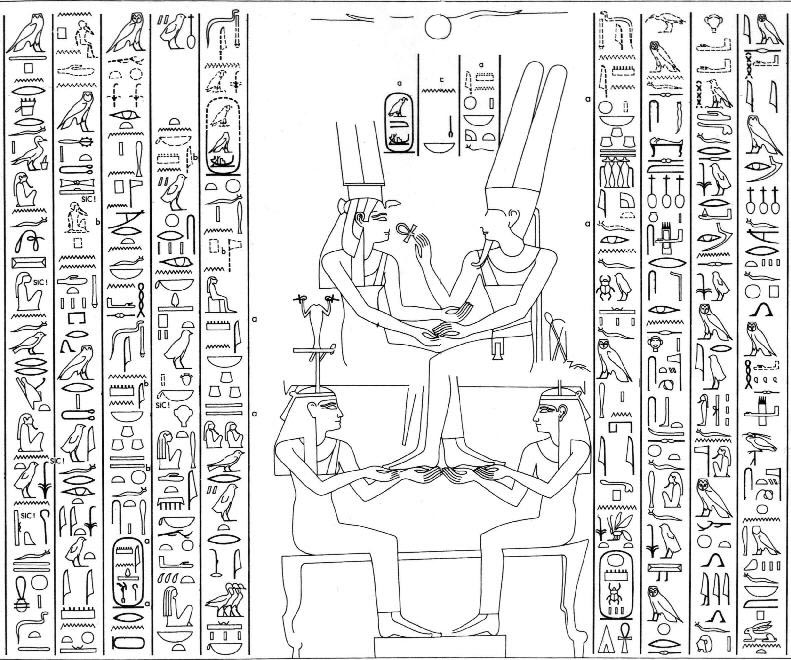
Regrettably, we inhabit a world in which Christians (and perhaps Abrahamic religions in general) vehemently oppose the very idea of an esoteric doctrine concealed beneath the surface of their sacred texts, particularly one of unknown antiquity. This resistance persists despite the fact that the early church fathers openly wrote about the existence of such teachings12.
The consequence of this opposition is that it blinds them to the authenticity of earlier expressions of the same mystery. For them, it is inconceivable that God could have been accessible to anyone other than the Jewish people. This perspective boils down to tribalism, pure and simple. Tribalism is tolerable when it remains confined to a small minority, but when it’s exported a global scale, it plants the seeds of conflict, genocide, racism, and suffering to a degree that is hard to accept for anyone with a sense of morality.
The Hindu nativity
Being introduced to Hinduism at a young age through the Vaishnava movement of the 1970s and 1980s (a.k.a the Hare Krishna movement) – I was subconsciously aware of similarities between the story of Jesus, and the story of Krishna. But it was not until I looked at the Christian material analytically as a mystic that the similarities surfaced in clarity.
In the narrative of Krishna, king Herod is called king Kamsa. And just like Herod in the new-testament, Kamsa is terrified to lose his power should Krishna be born. In a desperate move he ordered his subjects to murder every boy child in the region, a purge that is said to have lasted for fifteen years. During this time Krishna’s parents, Devaki and Vasudeva, is imprisoned several times and made to suffer in Kamsa’s prison.
What stands out the most in reading about Lord Krishna and the drama that took place surrounding his birth, is that king Kamsa ordered the murder of the innocents; a murder of children in order to kill Krishna. Krishna’s parents, Vasudeva and Devaki, eventually escapes into exile, taking the boy with them.
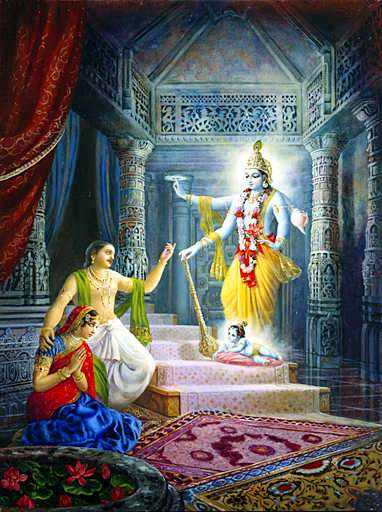
Critics of the Hindu nativity, which are typically literalist Christians or academics operating on the level of the story, usually point out the fact that Devaki, the mother of Krishna, could not be a virgin. According to myth she is said to have given birth to seven sons prior to the arrival of Krishna (sigh).
Reading about these seven sons, which there is not much material to find, it becomes clear that they represents the seven chakras. And as expected the chakras are personified as characters. The seventh chakra (Sahasrara) being the mighty and strong Balarama, the brother of Lord Krishna. There is also a sister, Subhadra, which is a goddess.
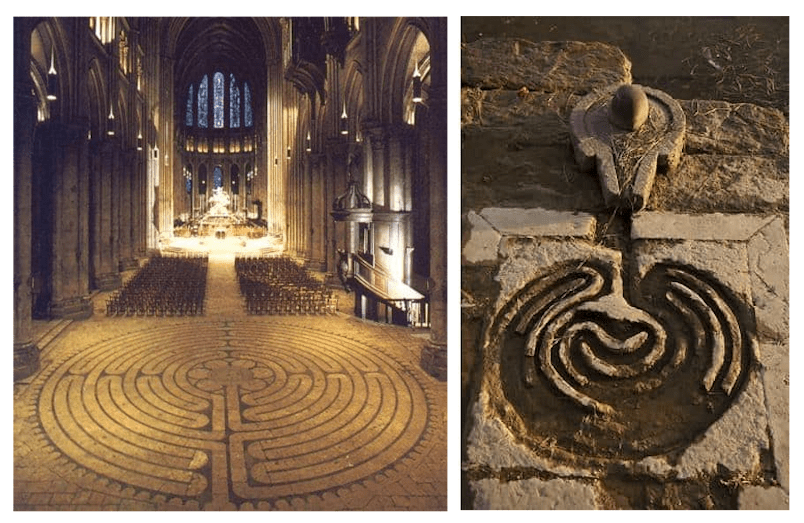
Right: Shivalinga with the maze of the goddess extruding from the yoni, the bottom part of the Shivalinga is called a yoni, literally vagina, of the goddess.
The adventures of Krishna and Balarama are numerous and fantastic, and depict the power-duo defeating demons throughout the sacred landscape. Many of the feats hold strong similarities to the ancient Greek stories about Hercules and his trials. A point that has been raised with regards to the Christian stories too 13.
Speaking of Hercules
At this point the Christian argument is often that there is absolutely no link what so ever between Hercules and Christ, and that such synergies are just wishful thinking in the minds of critics. They are clearly unaware of the seat of St. Peter, meaning the chair he is said to have literally sat on, which is on display in the basilica of Peter in Rome. This chair just happens to be decorated with the trials of Hercules. Quite a peculiar choice of decoration for a Christian saint, let alone a pivotal founder of the Roman church.
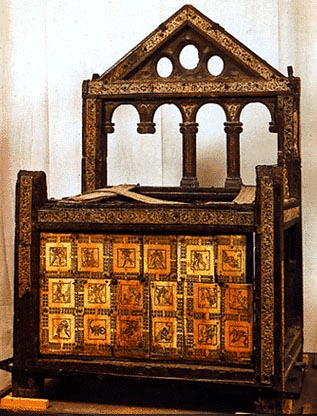
The circumstantial evidence so far, especially the unification aspect that I mentioned in my first chapter – where Christianity is ultimately a unification of all the mystery cults, Hercules included, should be more clear at this point. The early Christians had no sense of copyright, intellectual property or ‘mythological purity’. That was simply not how the ancient mind operated. As Timothy Freke and Peter Gandi outlines in their brilliant books on the pagan origins of Christianity14, the faith went through a violent and brutal ‘cleanup’ process when the Roman state became involved. The argument Rome used for this onslaught on early Christian lineages is echoed in the memoirs of St. Augustine:
That which is known as the Christian religion existed among the ancients, and never did not exist; from the beginning of the human race until the time when Christ came in the flesh, at which time the true religion, which already existed began to be called Christianity.
St. Augustine, Retractt. I, xiii16
What St. Augustine is saying here, bluntly and without any blemish, is mind-blowing:
- The true religion already existed prior to the advent of Christ
- This true religion had existed from the beginning of the human race
- After Christ came in the flesh, this un-named religion adopted the name Christianity
Stop for a moment to contemplate the full implications of that statement. That the true religion already existed, and have always existed. But when Christ came in the flesh, this religion just co-opted the name Christianity and basically took over.
The only religion that matches his statement, as having always existed among the ancients, is Hinduism. Hinduism is literally called Sanatana Dharma, the eternal doctrine. But I don’t think Augustine was thinking about Hinduism as a whole; Hinduism is an umbrella term for a myriad of lineages that all share the same symbology. He is hinting to something more subtle, the framework that is behind all religions. The knowledge of chakras, powers, nerves and the inner wiring of mankind. The disciplina arcani.
The mysteries of Ba’al
But it’s worse, much worse for the literalist. Because church father Irenaeus, a man who was central to the filtering process of which gospels were considered truth, and which were false, has this to say about the subject:
By these Christ was typified, and acknowledged, and brought into the world; for He was prefigured in Joseph: then from Levi and Judah He was descended according to the flesh, as King and Priest; and He was acknowledged by Simeon in the temple: through Zebulon [Ba’al] He was believed in among the Gentiles, as says the prophet, the land of Zabulon; Isaiah 9:1 and through Benjamin [that is, Paul] He was glorified, by being preached throughout all the world.
Church father Irenaeus, fragments of lost works, section 17 17
What the good church father is stating here is a nuclear bomb in theological terms. He is asserting that Christ was worshipped as Ba’al in ancient times, and that what became Christianity is ultimately the Ba’al religion. As preached by St. Paul, where we also found the chakras disguised as seven churches.
He also follows up this assertion by stating that Balam in the old testament was right, yet he was not believed by the priesthood of those times. Balam was the man that helped introduce Ba’al worship to Israel:
When, in times of old, Balaam spoke these things in parables, he was not acknowledged; and now, when Christ has appeared and fulfilled them, He was not believed. Wherefore [Balaam], foreseeing this, and wondering at it, exclaimed, Alas! Alas! Who shall live when God brings these things to pass?
Church father Irenaeus, fragments of lost works, section 1518
It is also clear from this fragment, that the early church fathers operated with archetypes. Being ‘typified‘ is ultimately to be associated with an specific behavioral pattern. Bringing an archetype into the world however, the creation of a deity to be blunt, is a study that goes far beyond the capacity of this book. But it is clear, without a shadow of a doubt, that the early Christian church fathers were well versed in the ancient mysteries, and seem to have wholeheartedly taken what they needed from them.
The insight that these early ‘champions of the faith‘ demonstrate and hint to in their writings, is not something that can be easily extracted from mythology. It appears obvious to me, although I cannot prove this as academic fact, that church father’s like Irenaeus and his ilk, had information that can only have come through initiation or close association with such cults.
If we now look at Ba’al worship and it’s symbolism, what do we find?
Truth is, there is not much left to study. The utter destruction of temples for gods that went out of fashion has been relentless. The walls have all been stripped of adornment, and only fragmented carvings in stone has survived.
There is of course the Ba’al cycle of Ugarit in written form, which I could decode quite easily, but to be honest I think the symbolic and architectural fragments alone speaks volumes:
- The ceiling of one Baal temple in Syria was decorated with a typical Saivite roof chakra, which symbolizes the Brahmachandra (the road of brahma, where the soul enter and leave the body), the gateway on the top of the human skull, which is equivalent to the Pantheon’s oculus, or opening. And as expected it features eight major divisions (sigh) and a total of twelve sections.
- An incense burner to Ba’al was found at Hazor, Israel, marked with the cross. The sun-cross (or coptic cross as we know it) was thus associated with Ba’al.
- Depicted in the center of the circle we find a woman holding a child, presumably the birth of Ba’al (read: the sacred seed). The virgin here being Venus, wearing a medusa mask. Medusa being nature in it’s raw, terrifying aspect. The fact that Venus is wearing Medusa as a mask, a mask that she has taken off, means that beneath the superficial terror of nature, there is love.
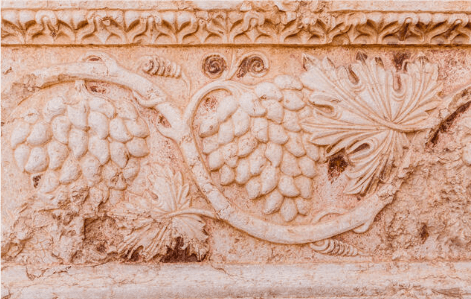
- We find that the walls were decorated with clusters of grapes and vines, which once again is a common Christian theme.
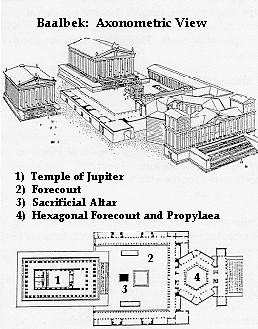
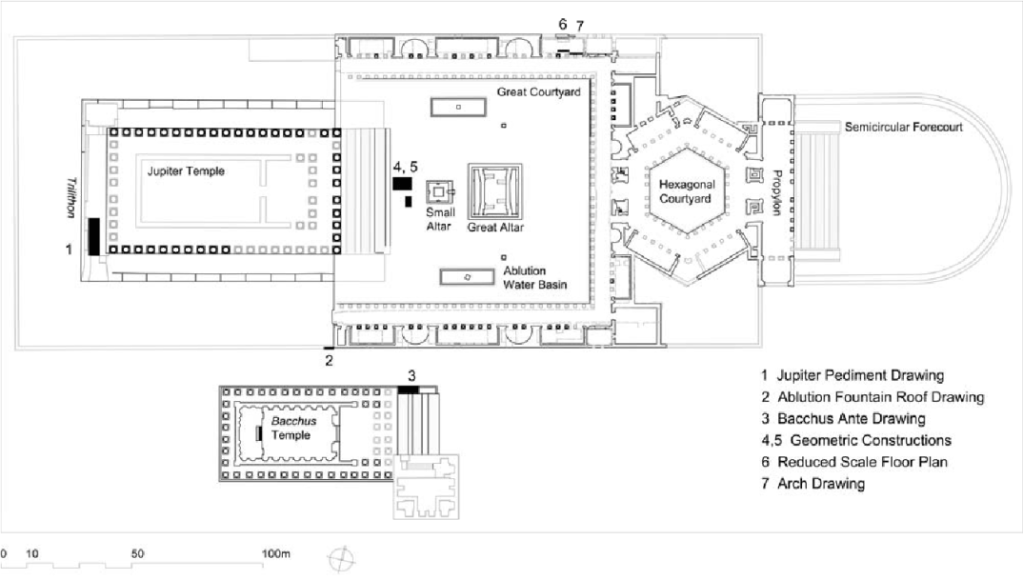
- And, more importantly, at the temple of Jupiter in Baalbek, Lebanon, we find stone carvings of Chakras. Only two have survived, which are Mulhadhara and Svadhisthana respectively.
- We also find that the symbol of Ba’al is a cross. Which explains why the jews were cast as the villains in the new testament. It was in all likelihood revenge for what Israel did to Ba’al worshipers and their temples in ancient times.
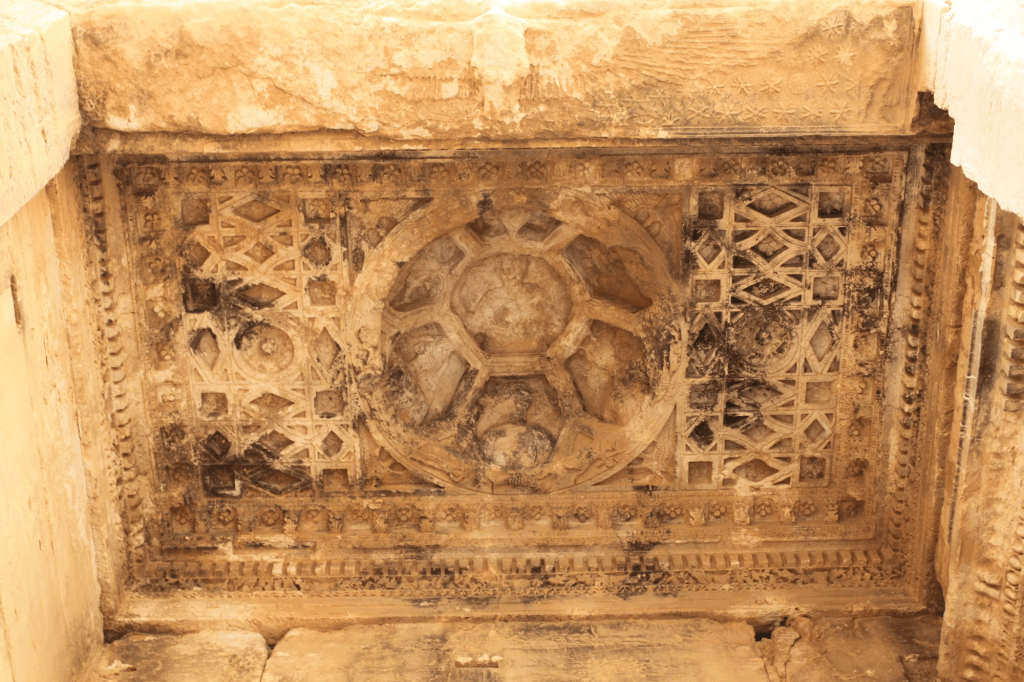
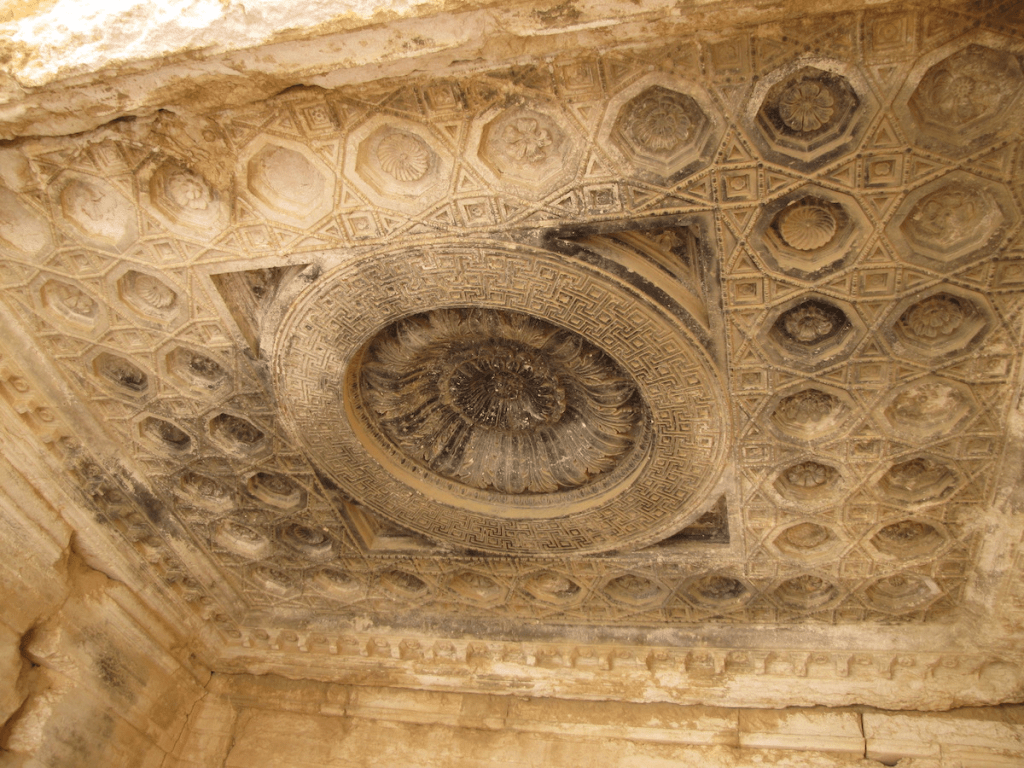
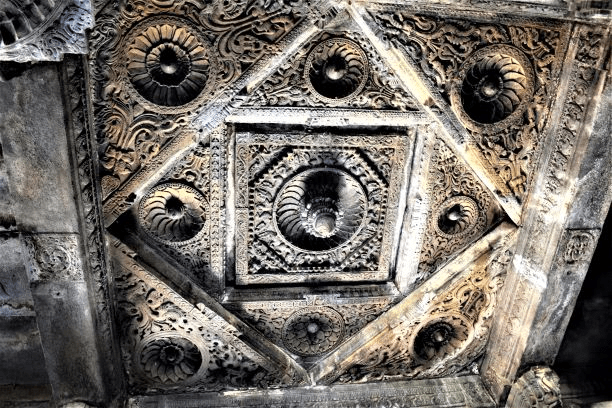
In existing, operational Saivite temples in India we find more or less the same type of ceiling carvings, both extruding and pertruding are common. Notice the eight points around the center:
Ba’al temples were typically decorated with grapes and vines, a common theme in ancient mystery traditions.
And finally, the last proverbial nail in the coffin, the Chakra decorations that have survived in Baalbek, Lebanon:
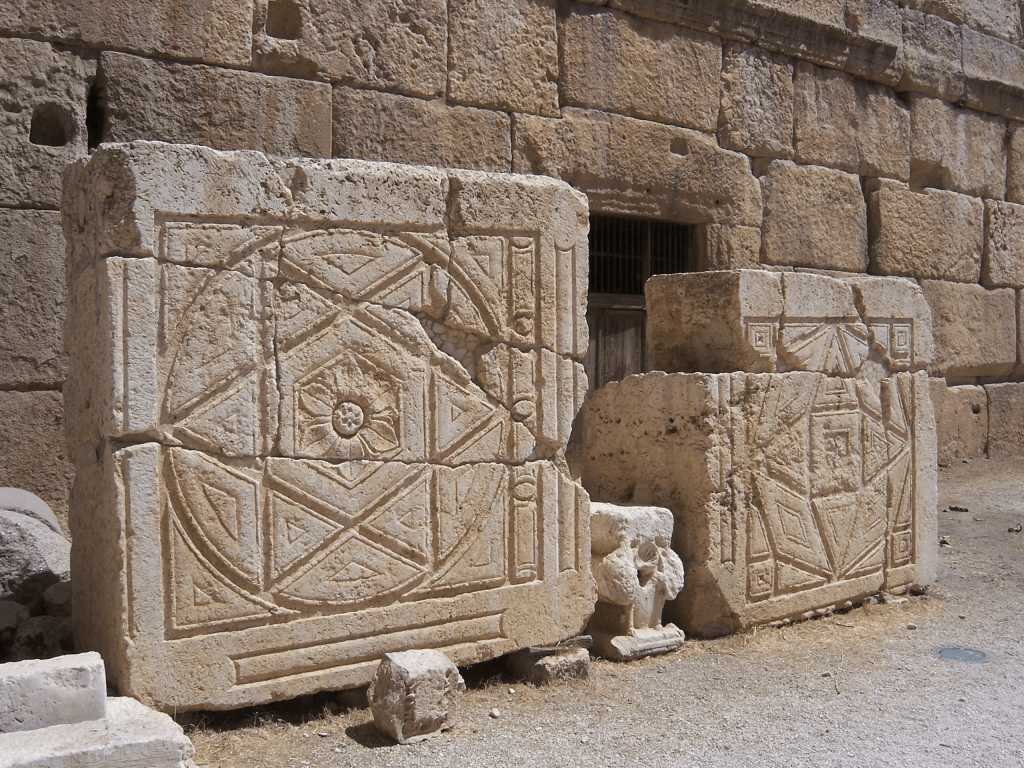
Here showing Svadhisthana and Mulhadhara respectively.
So regardless of how the literalists wish to argue, be it that the doctrine the Church father’s hinted to was of Greek origin, Egyptian origin, or indeed – established Roman religion — the result is the same. It all boils down to the Chakras and the esoteric knowledge they represent. The various mythologies and narratives that have come down to us, are simply masks and dresses applied on top of these underlying powers; to adapt the technology of salvation to various cultures and their temperaments.
Finally, we have something solid to work with.
The problem of salvation
The question of salvation and the means of salvation is a theological topic fraught with inconsistencies. It often involves circular arguments and intellectual contortions to make the narrative align with a literalist perspective. I won’t delve into an extensive theological analysis here, but off the top of my head, the means of salvation are predicated on the following preconditions:
- In order to be saved there has to be something to be saved from, some corruption that we want to avoid
- In order to avoid said corruption, the source of it must be subject to influence, be it divine or human (read: can we do anything about it?).
- If the source of corruption is outside the sphere of human influence, meaning that we cannot do anything about it, then salvation fully rests with the divine (read: we depend completely on external help).
- If however the source of corruption can be affected by the individual, and is within the sphere of human influence, then the means of salvation rests both with the individual and the divine.
Only once these questions are addressed can we even begin to entertain a discussion on the means of salvation or the role that individuals might play in such a process. It is here that early Christianity (read: original Christianity) and modern Christianity conflict with one another.
The issue with contemporary Christianity lies in its failure to provide satisfactory answers to these fundamental questions. Most of the time, the explanations offered by local pastors seem like simplistic and incoherent encouragements, jumping from one chapter of scripture to another, cherry-picking what is most self-serving and requires the least effort on our part.
Another mistake of modern Christianity is that they attempt to answer these things using science. A science that exclusively occupy itself with what can be perceived and quantified by material means. The result is always an unsatisfactory half-truth; a cake with a frosting of rationality, but with a filling of questions that are never answered in any satisfactory way.
There’s also the question of immutability: Is salvation once granted a permanent solution? Does lust, greed, and anger miraculously vanish once we declare ourselves as Christians? Clearly, this cannot be the case, given that many Christians live lives entirely contrary to their professed beliefs. Additionally, the historical record of the church and its misdeeds is enough to turn one’s stomach, indicating that there has to be a degree of individual responsibility involved, rather than placing all the onus on the divine.
What we observe is that original Christianity makes these matters perfectly clear, whereas modern Christianity diverges from these principles. In particular, Protestantism often teaches that Christ assumes the entire burden of your sins, both past and future, and all you need to do is say ‘sorry’ and carry on. However, this perspective is markedly different from the teachings of early Christianity.
In the early expressions of the faith, especially those outlined by the Egyptian desert fathers, and the eastern orthodox church for that matter, the concept of being ‘christed,’ as articulated by figures like St. Paul and Clements of Alexandria, had a very physical and tangible aspect to it:
Christ in you, the hope for glory.
The sacred seed, Christ in you
To the early Christians baptism and initiation was a process in which ‘something’ was born inside the human body. Something that is a tangible thing, yet only alluded to with the metaphor of a mustard seed.
- This seed is said to be born in the region slightly above the solar plexus, within the house of Virgo, and it emerges toward the left side at the lower part of the ribcage.
- Once this seed is created, it begins to traverse through the body, purifying each chakra along the way, causing significant discomfort, to say the least. Especially when it pierces the liver.
- The narrative of Jesus essentially portrays the journey this seed undertakes within your body and the profound transformations it brings about in your personality and mind. These changes are beyond anything that personal efforts alone could ever achieve.
- The “dark night of the soul,” as referred to in Catholic terms, is when the ego undergoes dissolution as a consequence of this transformation. At this stage, the focus shifts from the external world to the inner realm. The inner becomes more important than the outer. You are still here, but not as you used to be.
- The seed is a spiritual phenomenon, meaning that it cannot be measured or quantified by any instrument material science have at it’s disposal. As always, spirit cannot be seen or touched, it can only be felt or perceived by the mind. Most people have never had such an experience, and have never felt their own spiritual body (which reacts to spiritual phenomenon and energy). Without that experience, the existence of your own inner architecture remains a myth.
This seed, which goes by various names (it was primarily venerated as the sacred bull in ancient times), serves as the agent of purification. However, it is entirely possible to disrupt or halt this process, either intentionally or unintentionally.
How exactly are westerners supposed to navigate such processes when there are no available teachers to guide them? I speak from personal experience here because this is precisely what happened to me. I underwent adult baptism as a mere formality – only to receive a full Kundalini awakening.
But when I turned to the church for guidance (in what I hoped was a common phenomena), I encountered nothing but a void. Frankly, they had no comprehension of what I was talking about – and I was simply left to my own devices.
Thankfully, my prior study of Hinduism and Buddhism as a teenager allowed me to recognize some of the phenomena. Lord only knows where I would have been without that knowledge. That led me to seek help with them. I can safely say that without the help of a kind Tibetan monk that took pity on me, I would most likely have suffered a complete mental breakdown.
Reflections
For me, reflecting on these things thousands of years after the fact, like sifting through echoes of what once used to be; it appears that as we have distance ourselves more and more from the ancient world, this underlying, esoteric doctrine has diminished at an alarming rate. Eventually, the literal, exoteric, and absurd interpretation of scripture will have eroded away all knowledge of what was once regarded as mankind’s most priced possession. In some ways it already has, as the material I have shared here is typically reserved for academics who study each part separately, and cannot by virtue of academic principle connect the dots between cultures or cults.
Yet we are left with a loss of something important, something that I think most people instinctively feel, but are unable to concretize. Something is missing. Something has been lost; something extremely important, yet equally elusive. A technology of the soul that enabled man to commune with the sacred – and consequently experience the divine directly and without distortion.
The west has been through absolute hell. These men, these popes and inquisitors, have put mankind through a nightmare that lasted for almost two thousand years. All things considered I am actually impressed that western society still exists, although we are but a shadow of our former selves.
Honestly though, I don’t think these millennia have been completely wasted. We got rid of a lot of doctrines and practices that were absolutely abhorrent and insane. Everything from child sacrifices to men castrating themselves believing that’s what the goddess wanted. Absolutely insane ideas that Christianity helped get rid of. But there is no denying that the church went about this business with a chainsaw, and came with a fair dose of madness themselves. In some cases a chainsaw was indeed the correct tool for the job, but in many, many other cases a scalpel would have sufficed. They have in some respects thrown the proverbial baby out with the bathwater.
The esoteric doctrine I seemingly chanced upon appear to have persisted as an undercurrent in Western society throughout the Middle Ages. The architectural designs of the Templars likewise embodied a corpus of knowledge that hints at a hidden legacy of uncommon insights. Similarly, the Gothic cathedrals, particularly Notre Dame in Paris, France, communicates the presence of the same mystical arcana through it’s architecture.
From the Enlightenment era onwards, it seems that this doctrine found temporary refuge in the hands of Freemasonry, which, at least for a certain period, displayed an understanding of the symbolism involved. Their temples, lodges, and published materials (such as Albert Pike’s “Morals and Dogma”) demonstrate a deep insight into the esoteric arts.
However, as we enter the Victorian age, this esoteric doctrine abruptly disappears. It simply ceases to be ‘common knowledge.’
This disappearance can be attributed to several factors, not all of them something the church or literalism can be blamed for:
- The destruction of pagan shrines and symbology
- Fragmentation through the relentless Christianization of Europe
- Burning of ‘pagan’ literature by the church
- Persecution of ‘pagan’ teachers and alternative Christianities
- Loss of knowledge through natural disasters and human conflict
- Evolution of what will become modern chemistry
- Medical and anatomical knowledge
- Scientific thinking and analysis of natural phenomenon
And finally, the arrival of the industrial revolution, public education and medicine that does not need divinity or meaning to operate.
At this point the proclaimed historicity of the gospels, which had worked so well for both Catholics and Protestants in the past, began to work against them. It slowly but surely became obvious to the western mind that the historicity claim was flawed, and thus the faith became infected with doubt.
Had the church retained the esoteric core through the ages, not only would the world had shed it’s barbarism faster, but the faith would have been far more resilient. The church has boxed itself into a corner where the entire debate occurs on the level of the story, the superficial narrative — a position they themselves have cemented. This makes it impossible, or at least extremely difficult for them to embrace the esoteric wealth in the gospels. Let alone what science has to offer in the realm of physics.
Reference material
- The anatomy of a church, John MacArthur, ISBN 9780802451323 ↩︎
- The Temple of Man, R. A. Schwaller de Lubicz, ISBN 9780892815708 ↩︎
- Topographical and Anatomical Aspects of the Gothic Cathedral, Journal of Aesthetics and Criticism 20, no. 1 (1963): 3-23. ↩︎
- The Hindu Temple, Stella Kramrisch, ISBN 9788120802223 ↩︎
- The Buddha, ChaChakkasutta, Majjhima Nikāya 148 ↩︎
- Tibetan tantric practices, Wikipedia article ↩︎
- Gautama Buddha, Nagara Sutta, The city ↩︎
- Georg Dehio, Gustav von Bezold: Kirchliche Baukunst des Abendlandes. Stuttgart: Verlag der Cotta’schen Buchhandlung 1887–1901 ↩︎
- The stories of Ganesha, Shubha Vilas, ISBN 9789354400865f ↩︎
- Bhavisya Purana 19:23, Rasbihari Lal & Sons, ASIN B072VY4LM5 ↩︎
- Introduction to Kaballa: Based on Rabbi Chaim Moshe Luzzatto’s; Kalach Pitchei Chochma, ASIN: B000EAP998 ↩︎
- Whitty, John. “Rethinking the Disciplina Arcani.” Studia Patristica. Vol. CIV – Papers presented at the Eighteenth International Conference on Patristic Studies held in Oxford 2019 (2021): 85–92. Web. ↩︎
- The Jesus Mysteries, Timothy Freke and Peter Gandy, ASIN: B07FPT9PKM ↩︎
- Chair of St.Peter, St. Peters Basilica ↩︎
- Chair of St.Peter, St. Peters Basilica ↩︎
- St. Augustine, Anna Kingsford: Her Life, Letters, Diary and Work. Cambridge Library Collection. ISBN: 9781108072748 ↩︎
- Church father Irenaeus, fragments of lost works, section 17 ↩︎
- Church father Irenaeus, fragments of lost works, section 15 ↩︎
- MukhaLingam, Wikipedia ↩︎

