In the previous chapters we have gone through several important steps, from the discovery of the chakras hidden in the gospels in the first chapter, to the universality of gods and teachings across cultural boundaries and ages in the second chapter. We also saw hints of how the gods of the ancient pantheon, the twelve gods, had been recast as disciples of Christ in the Christian gospels — as evident with the virgin Mary who without any doubt is a recast of the primal mother goddess.
These chapters, while much needed steps on our journey, deal primarily with context. In order to understand something correctly, it has to be seen within a context that provides meaning, otherwise recognition is going to be difficult. If not outright impossible. So the more correspondences we can accumulate from the ancient traditions, the easier it will be for the mind to synthesize a correct view.
Comparative framework
I have mentioned that I operate within a framework when I study, meaning that I have some rules that I always try to follow, which helps mitigating errors and avoiding misinterpretation. When it comes to symbolism and esoteric meaning, I always have a rule that at least 3 correspondences must be involved. Meaning that a symbol should match on at least 3 points to be deemed a potential candidate (or with merit is perhaps a better phrase).
A good example of this technique is what I demonstrated in the previous chapter when deconstructing the symbol of the virgin Mary. With her the minimum three correspondences were:
- Virgin either by name or attribute
- Accompanied by or associated with a lion
- Pregnancy without carnal intercourse
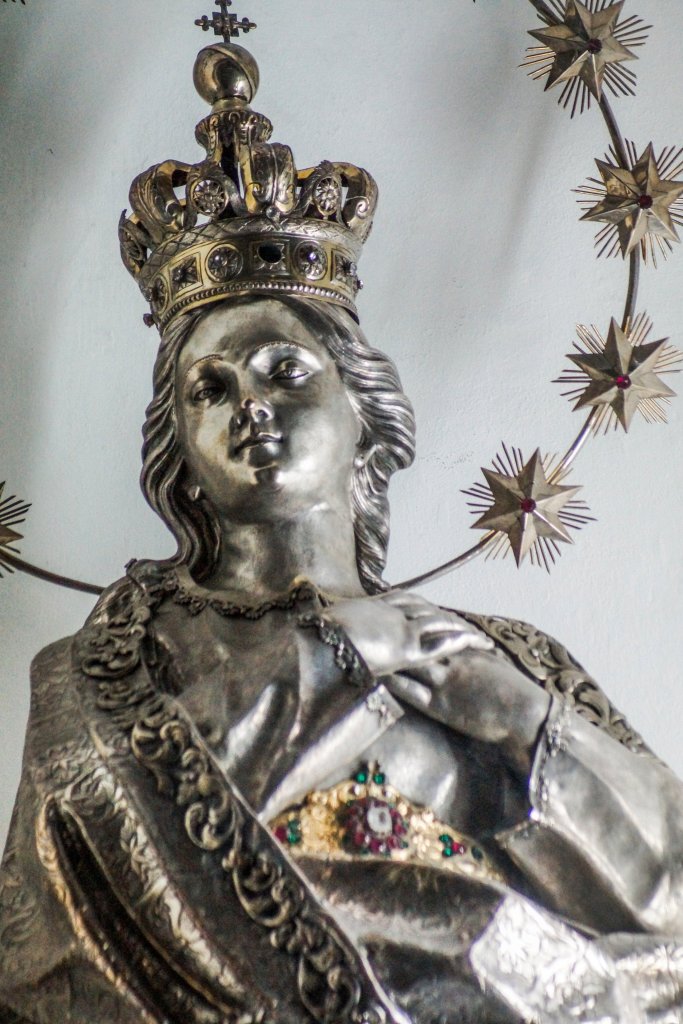
Further context that help in validation of the symbol in this case, would be the following:
- Associated with the solar plexus, mountain region or valley
- Birth of a child through the left side of the torso or other non-natural means
- Emphasis on mercy and compassion in character, but also with a ferocious aspect when confronted with evil or injustice
The mountain region
The association with the mountain region or a valley might not be immediately obvious to those that are new to sacred anatomy. In ancient thought the body was regarded as the sacred landscape, a miniature of the cosmos and all it’s forces. In this metaphysical landscape the torso was seen as a mountain region, while the human head represented the highest mountain, the mountain of God. Examples being:
- Mount Kailash (Hindu: Shiva)
- Mount Meru (Hindu: Vishnu)
- Mount Olympus (Greek, Zeus)
- Mount Nyssa (Greek, Dionysus)
- Mount Sinai (Semitic: Jewish, Yahve)
- Mount Zaphon (Semitic: Canaanite, Baal)
- Golgotha (Christian, Jesus)
The point I am making here is that I have not arrived at my conclusions haphazardly, or purely by comparing visual attributes. If all I had done was to compare what looks similar across religions and cultures, the margin for error would be astronomical. It would make me no better than fundamentalist zealots that blindly label everything they don’t agree with as acts of the devil. That is not the case.
So while the assertions I make will be unfamiliar – if not alien – to the average Christian, every symbol and myth that I write about have been subjected to the method I just outlined. The reason I havent detailed every single aspect about every factor involved, is ultimately a practical one: for established, commonly known symbols alone, the footnotes and source references would be monumental. There is also a challenge in that my findings, such as the reverse engineering of the chakra system in the new-testament through their references to Greek mythology, is quite simply unheard of.
It might come as a surprise, but I appear to be the first to have made all these connections. It sure is surprising to me as well. No doubt our modern day easy access to digital books and texts have given me an advantage. Let us leave it at that.
Comparative mythology
You will not find a book on comparative mythology and religion that demonstrates the technique I am applying. There have been mention of the seven churches being ‘symbolic of chakras‘ in new-age circles for decades, but when asked to explain how they arrived at such conclusions, they are unable to answer. I think that many individuals intuitively feel that the seven churches must be the chakras, but are unable to document why that is and how they arrived at such a conclusion.
Perhaps more importantly, my work is not intended for academia but for those that genuinely seek the divine. Academia operates with objective facts, not subjective truth and meaning. Christianity is (imho) not a topic suitable for academic research beyond pedigree, dating and textual analysis. The academic circles that research Christianity operates purely on the level of the story, which they regard as historic due to the narrative being superficially anchored in such a context by the authors. Which is common for sacred texts to make them relevant for the audience living at a particular point in time. Sadly most academics seem oblivious about this.
The moment you move from analysis of facts, to analysis of meaning, you have more or less moved away from mainstream academia. Which is as it should be, because the esoteric landscape deals with subjective truth, not objective fact. Religion is about the experience, not theory or dogma; only literalists engage in such nonsense. That divide is ultimately the human brain, with it’s logical, analytical left -and it’s intuitive, non-linear right. Both must be applied to get results.
I want to stress that I am not trying to criticize academia, absolutely not – their work is invaluable and highly appreciated. This journey is not a matter of ego for me, nor do I consider myself more or less intelligent than other software engineers, which is what I do for a living. My ability to see and recognize things is actually nothing I can take credit for at all.
After my initiation I was gifted a powerful kundalini experience, as I mentioned briefly in the previous chapter, and it was only after this experience that the veil was lifted. Whenever I picked up a sacred book during this phase, regardless of which, I was suddenly able see that the text had further layers; hidden, so to speak, beneath the superficial surface narrative. So whatever credit might be given in this regard, I place that wholeheartedly where it belongs, with the spirit that teaches and informs those that seek God with an open heart. My only contribution has been my passion for the subject.
A lost secret
The disciplina arcani is, in whatever format it was introduced to the west, lost to time. Reconstructing it can only be done indirectly, by assembling as many parts as we can and synthesizing the most likely missing parts. Once we have such a model, we can further compare that with ancient traditions that are still alive.
This is why Hinduism (Saivism in particular) and Tibetan Buddhism is so important, because these represent more or less the only living traditions from the ancient world that remain largely intact; traditions that we can enter ourselves and experience the validity of directly.
Christianity is likewise a vibrant, living path to take, as long as the individual understands what the framework represents. Superficial, mass-media driven Christianity is, in my view, the real danger. This is a sacred, inner journey, not the absurd psychopomp spectacle people engage in today. Wide is the gate indeed. Choose the less traveled path and you will find him.
Having said that, most of the information I have presented here is not going to be familiar to the average, semi secular Hindu or Buddhist either. People are people and we tend to absorb and know whatever is given to us through the culture we are brought up in. Most of the western symbols which are clearly derived from eastern originals in the remote past, will not be recognizable to a modern Hindu Saivite or Vaishnava Bhakta. As with all religious traditions, emphasis is on doing the work, not engaging in ancient riddles or precursor symbolism.
So a Buddhist is not automatically interested in finding out where the term ‘eightfold path’ might have originated. He or she will be occupied with what it means to them, what their lineage have transmitted to them, and what it means for their quality of life in the present. That it might have some reference to eight nerve-paths in the human skull has little practical value from their point of view. Such things only have value when you are actively researching the esoteric, which is what this book is about.
Before we continue, we need to concretize the information from the previous chapters so that it forms a more tangible map. This is where things become interesting and all that reading yields fruit.
The twelve and the seven
In the previous chapter I outlined the importance of the zodiac man with regards to western spirituality, because it is here that we find the archetypes common for mythology and religion in the ancient world.
The question is then — how does the zodiac fit into the concept of 7 chakras? This was a puzzle that took some time to solve. I found the solution on one of my journeys, visiting the Cathedral of Palermo, Sicily. There the floor was decorated with the zodiac sigs organized into seven groups along a meridian line. A line that defines true north, turning the entire church into a giant sun-dial.
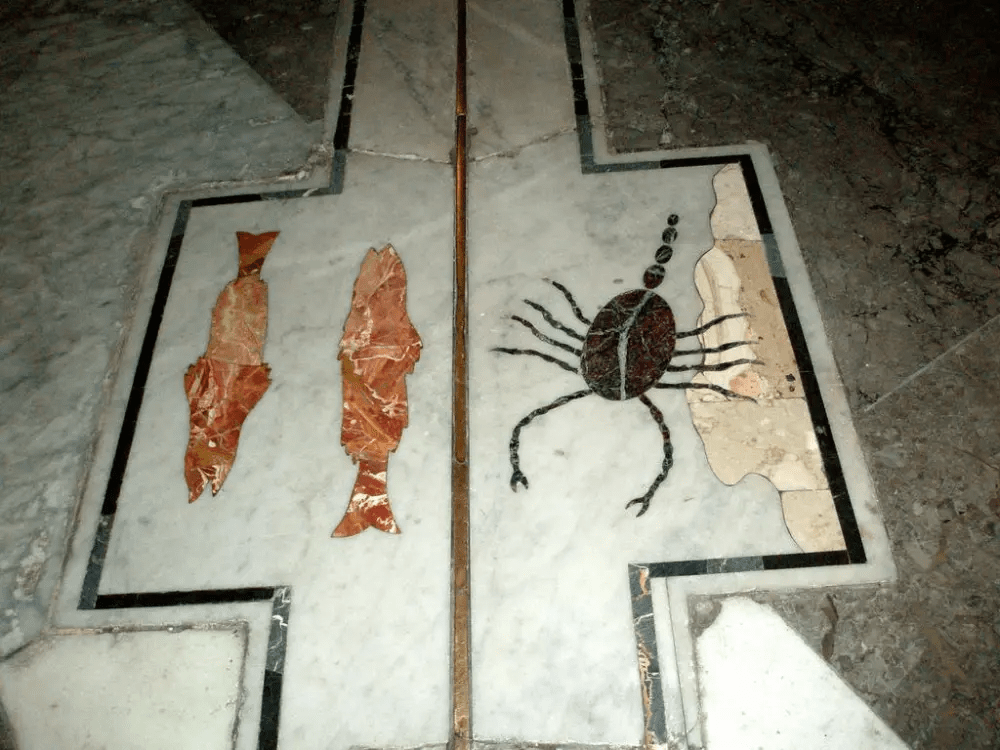
What must be understood here is that the zodiac signs were, in ancient times, both seasonal markers used with regards to nature and it’s cycles — but it also served as medical symbols. The medical symbols were likewise used in mythology, as markers of the secret doctrine.
Further, they were mapped to the main planets of our solar system, representing the chakras of the father (Purusha | Pater). So the system was literally at the heart of life on this planet, and touched every aspect of the ancient mind.
The world they saw when they walked out the door in the morning, was not the same world as you and I see.
The alpha and the omega
In the seven chakra model, the first and the last contain only one deity. The first is Mulhadhara which is operated by Ganesh, which is John the Baptist in Christian terminology. The highest chakra is Sahasrara, which is operated by Lord Shiva, the ‘lord of the mountain’, El Shaddai in Hebrew (as is written in the old testament). Mahadeva, ‘lord of the assembly’ the Elohim.
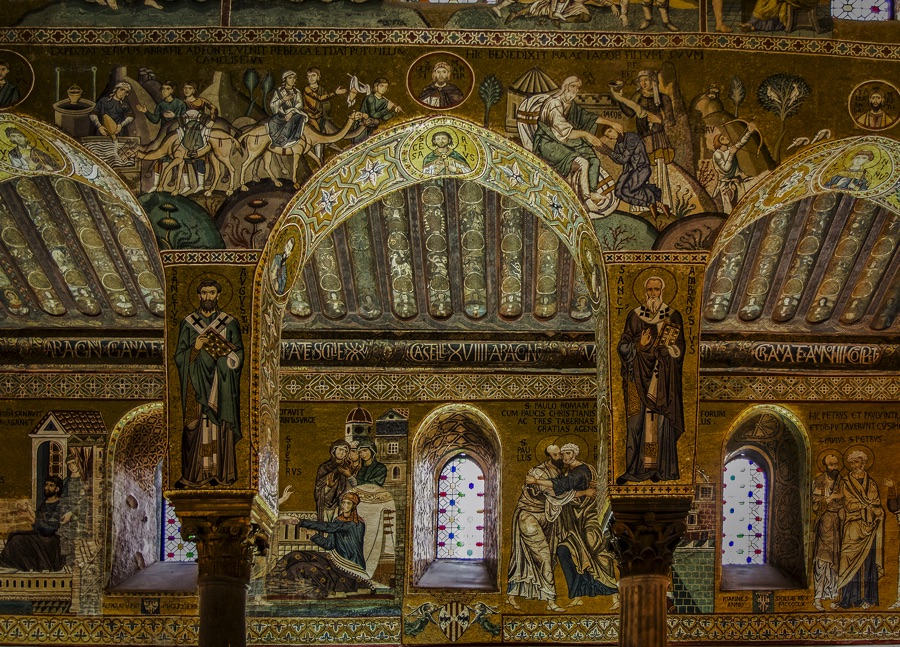
Source: Palatine chapel, Palermo, Sicilia
This leaves 10 zodiac signs which neatly fits into the five remaining chakras as groups of two. The five middle chakras each contain two conflicting principles. I write conflicting because their natural operation, from the view of Christian mystics, represented our the fallen state. The chakras are configured according to your karma and nature.
The whole point of the secret doctrine, or true religion in general, is to re-configure these chakras so that the positive and good principles in each of them takes over, so to speak. The map we thus end up with, is this:
- Aries (head)
- Taurus + Gemini (neck, heart)
- Virgo + Leo (lower heart, solar plexus)
- Cancer + Libra (abdomen, hips)
- Scorpio + Capricorn (genitals, tailbone)
- Sagittarius + Aquarius (thighs, chin)
- Pisces (feet)
Which maps directly to the seven chakra model of the east:
- Sahasrara
- Ajna
- Vishuddha
- Anahata
- Manipura
- Svadhisthana
- Mulhadhara
And further to the cities in St. Paul’s narrative:
- Ephesus
- Smyrna
- Pergamos
- Thyatira
- Sardis
- Philadelphia
- Laodicea
Now things become interesting! Because now we can likewise get to work on older landscapes, such as Homer’s Odyssey, and even more complex motif’s such as Dionysus – which is without a doubt at the core of Christianity. The miracles that Jesus performs on his journey are, for the most part, copied from the Dionysus cult before the Christian unification.
Anyone in the first century who heard that Christ had uttered ‘I am the true vine‘ would automatically recognize it as Dionysian. Dionysus being the last religion that Greece imported from India and adapted to Greek culture and symbology.
As Alain Daniélou describes in his work, researching the origins of the lost, distinctly European, Dionysian tradition:
Delphi functioned more or less as a miniature Varanasi, complete with Shivalinga worship. The Greeks would pour wine, milk and honey over the Omphalos stone, just as Hindus pour milk, water and honey over the lingam to this day.
Alain Daniélou, Gods of Love and Ecstasy, The Traditions of Shiva and Dionysus
This is where we move from synthesis and symbolic research, to the practical and experiential.
Dionysian symbolism
Having connected the dots, so to speak, between the chakras and zodiac signs, let’s look at the decoration from the ‘vila musterion’ that survived largely intact in pompeii.
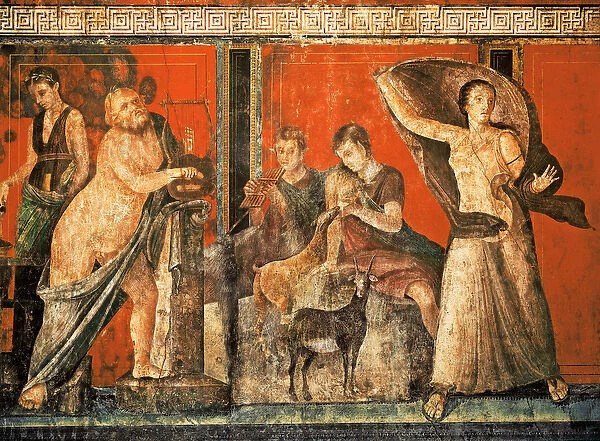
Look closely. The man stands on two columns. His right foot on a broken column, while his left foot is on a raised one, reaching up to the torso. Emphasis on the thigh and hip region is likewise obvious (Sagittarius). The lyre’s root is held at the house of virgo. The emphasis on the left column makes dionysus a purely shakti oriented approach, relying on the lunar energy rather than the solar. His right column being broken off literally at the foot, the house of Pisces.
In the next composition the musician on his left has stopped, watching his companion which is obsessed by nature, observing the fauna. The flute player being the observer. The two men are obviously the twins, the heart, one bird eating the fruit, another watching. Dioscuri. The goat a reference to the head, the house of aries. These are the upper chakras of heart and head.
Finally, the woman throws off a veil. A pretty common symbol of “lifting the veil of nature” to see the true reality beneath. Not unlike the rending of the temple veil in the NT. Notice the arch of the veil, the solar arch of perseus, and also that her right arm is used to lift it – while her left hand makes the gesture of “fear not”.
There is clear astrological markers being deployed here, but those are not astrological in the conventional sense, but rather as as esoteric process (i.e. zodiac man, medical symbolism).
Every piece here has meaning. The woman to the immediate left of the old man is wearing a belt, tied twice beneath the breasts. That was only used by pregnant women. Yet she is not physically pregnant, pouring wine. That is ofcourse the cup bearer, aquarius, the prana pumps of the lower legs. The cup is held adjacent to Svadhistana, second chakra.
Summed up the painting disclose the following:
- Pisces (feet)
- Aquarius (ancle)
- Sagittarius (thigh)
- Gemini (heart)
- Aries (crown)
What we are seeing here, is actually the energy pathway as shakti enters the body through the feet, and journeys up through the abdomen, through the lunar nadi, iluminating the heart chakra, and ultimately short-circuits logic and waking consciousness, allowing the adept to experience raw, unfiltered reality. The lyre symbolizing the use of sound (mantra) which is vital for these processes.
Dionysus is a very real psycosomatic power. His beeja mantra causes an enormous flux of energy from the thighs, which are the proverbial batteries of the human body (the pillars of Hercules). Even after few repititions i had to stop, because the influx was of such potency that i nearly passed out. And i have been doing mantrayana for 30 years.
This is an extremely dense, subtle and complex motif to decompose, but also thrilling to analyze since nobody is really approaching this old cult material as a mystic. The endeavors so far has been purely academic, which cannot navigate the type of framework we see deployed here.
But we now have a framework that works and a model we can use to navigate the mysteries of the ancients. It is by no means perfect, but as I hopefully have demonstrated so far, it does yield some interesting results in the right hands.
 Disciplina Arcani