Genesis and the nature of sin
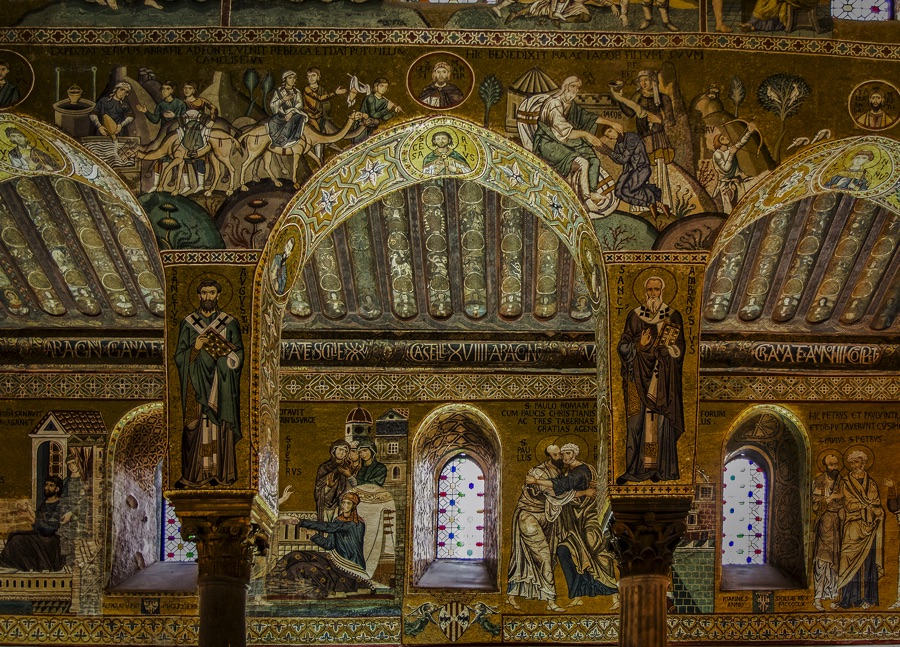
In literalistic Christianity it is, broadly speaking, taught that the source of sin is a talking snake (sigh). According to this narrow view, our human predicament stems from us having inheriting some form of transmitted guilt from our distant ancestors for eating a piece of fruit.
If we entertain this idiotic narrative as literal fact and examine this text accordingly, an immediate question arises: Why would God place our ancestors in a garden with such danger? It’s akin to putting a small child in a playpen with a loaded gun. No responsible adult would ever consider something like this, let alone the almighty creator of the universe (!).
So when read as literal fact, Genesis is more of an affront to the divine and portrays God as a shortsighted, tantrum-stricken bully who has no regard for humanity. It’s perplexing why anyone would accept such a portrayal of God, especially when life itself, with all its wonder and diversity, contradicts such a notion.
An alternative view, which likewise sprang to mind in ancient times, is that the narrative must be interpreted as a kind of theatrical opus, much like the Greek dramas or plays that were introduced into the region through Alexander the Great. Alexander, during his conquest of the Jewish levant, Hellenized the Semitic tribes at spearpoint -and it’s worth noting that the Jewish texts we refer to as the Old Testament (Septuagint) were actually translated under some duress in Alexandria; ordered by Ptolemy Philadelphus II, the Greek Pharaoh of Egypt. In such a theatrical drama narrative, Eve would be meant to say yes to the snake, and Adam was meant to partake of the fruit she offered him –and God was angry and bombastic because that is how the Greeks portrayed Zeus in their mythological framework.
This is where Gnosticism emerges as a significant force during the first centuries of Christianity; as an amalgamation of Semitic religion and the Greek mystery schools.
The Gnostic approach
Interpreting the story as a symbolic theatrical play on a deeper truth -more or less encapsulates the gnostic approach to these texts. In this school of thought, the serpent isn’t viewed as the villain but rather as a liberating hero. Within the gnostic Christian tradition (which predates the synoptic tradition of Rome by some margin), the bombastic and wrathful deity of Genesis is actually the demiurge, meaning “half maker” (equivalent to a confused god). In Hindu terminology, this figure would correspond to Brahma, the creator God.
In Hinduism, Brahma is seldom revered, primarily because of his attempt to declare himself the highest God. He even lied to Vishnu and Shiva in a blatant display of egoity. Shiva, the supreme deity who created both Vishnu and Brahma in this narrative, decided to correct his deluded offspring by severing one of Brahma’s five heads. A very direct display of authority. This particular head looked upwards, towards heaven, symbolizing the window to heaven that inspired the many ideas Brahma mistakenly imagined was his own.
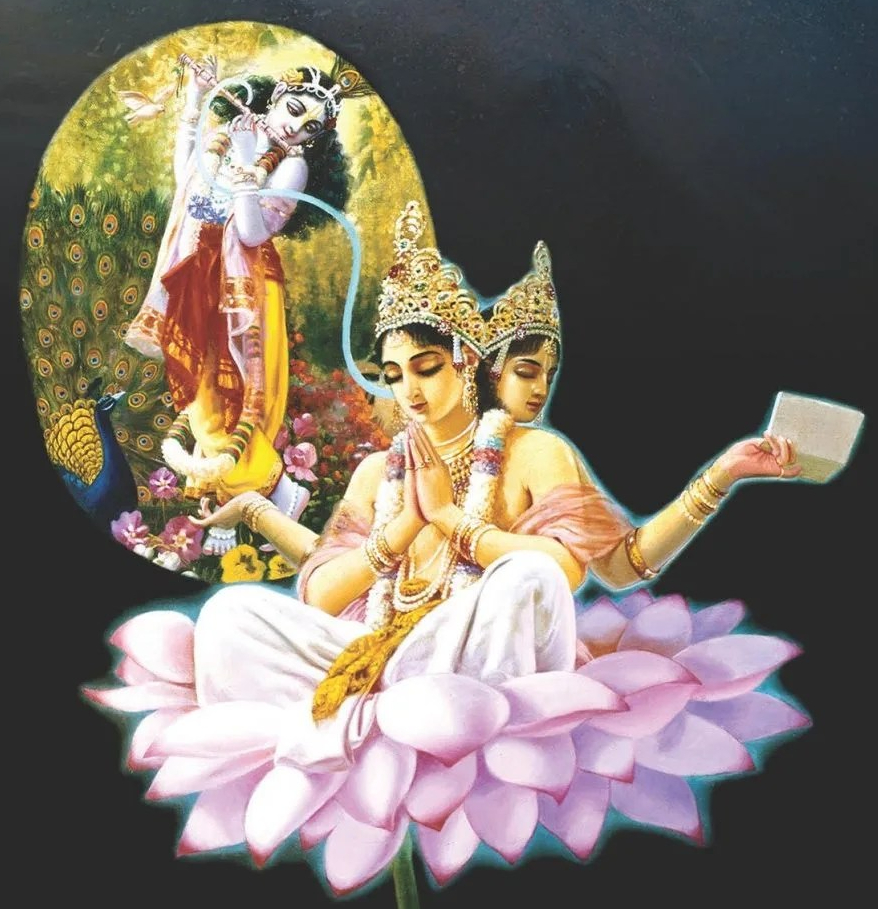
As punishment for his stubbornness and falsehood, Brahma faced a reduction in office, effectively being reduced to a managerial figure. In every universe, every solar system, and ultimately within every sentient being, there is a Brahma who manages the creation and unfolding of the construct. So, after being put in his place, Brahma receives instructions from above on what to create rather than falsely claiming to be the source of these ideas.
Interestingly, the gateway on top of the human head which the soul is said to enter the body at birth, is called the Brahmachandra, the gateway of Brahma. It is difficult to ignore the synergies between Brahma and our own situation. Defiant and full of ego as humanity is.
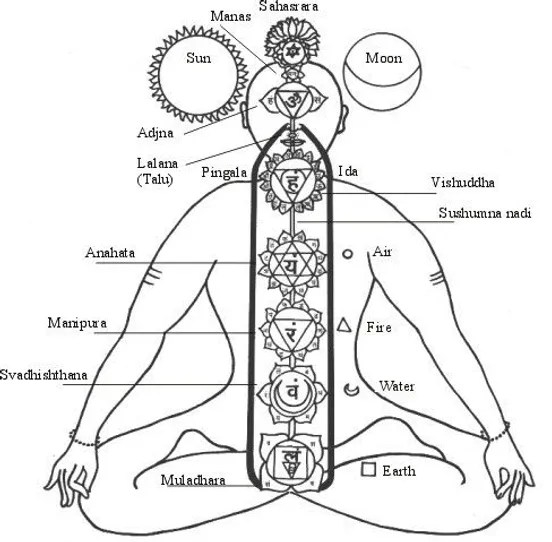
In the realm of biology, Brahma is however first and foremost associated with reproduction. The primal, first expression of creativity, specifically the second chakra known as Svadhisthana. His rude behavior towards Shiva and Vishnu carries clear symbolic meaning, representing how young men can behave when overwhelmed by potency and the burdens of youth. Additionally, it symbolizes ego, self-glorification, and ahamkara, the psychological function responsible for perpetually creating our self-image, self-identity, and consequently, the suffering that arises from acting on these delusions of grandeur.
When Svadhisthana is purified however, something significant occurs in relation to lust within the body. In short, lust disappears as a consequence of this purification. However, there is an initial struggle as the adept must practice celibacy for roughly a month (the duration may vary from person to person, but it typically ranges from three weeks to three months), which is exceedingly challenging for most men.
When I refer to celibacy, I’m not solely addressing the physical act of avoiding intercourse; it extends to every thought of sex or arousal that must be transcended. If such thoughts take hold and give rise to a physical response, the semen will burn, causing pain. In this case, the aspirant must release the accumulated fluids and begin the process anew. Throughout this phase, constant chanting of mantras, particularly Ganesh’s beeja mantra (root mantra), must be performed. Whether walking, sitting, or working, the mantra must be chanted ceaselessly within one’s consciousness. It serves as armor in the battle with one’s lower nature. Ultimately, when Ganesh (John the Baptist) deems it appropriate, the gate to the temple will open, and Svadhisthana activates. This activation is felt as a spinning wheel located 2-3 fingerbreadths beneath the navel, and lust instantly dissipates. This experience is referred to as ‘turning the flow of the Ganges in reverse,’ as the vital energy now ascends, being recycled by the body to strengthen it. The river Nile in Egypt interestingly also flows upwards, a detail the ancients were aware of with regards to where they constructed cities and monuments.
For those who do not possess knowledge of the relevant mantras, the potential consequences are uncertain. However, we may see some of the underlying issues that have contributed to the sexual scandals haunting the Catholic Church. While abstaining from sexual activity requires stamina, the ultimate goal is the purification of that energy, and that requires mantrayana. Otherwise you’re just a horny celibate, as the late American yogi, baba Ram Das put it.
Without the use of Mantra, enlightenment is impossible.
Tantra in Tibet by H. H. the Dalai Lama, Tsong-ka-pa, Jeffrey Hopkins
As you can see, the Saivite narrative surrounding the beheading of Brahma bears some intriguing parallels to this inner transformative process. During this phase, the internal struggle can indeed be brutal, and the sexual impulse will relentlessly attempt to lure you back into old habits of lust and adherence to ‘the way of nature.’ It strives to assert dominance over you, much like Brahma attempted with Vishnu. However, once the individual has proven his resolve, Brahma is put in his place as a servant. This ‘beheading of ignorance’ and consequent redirection of energy are crucial elements of the process.
As Christ says in Matthew:
If anyone desires to come after Me, let him deny himself
Matthew 16:24–26
So from this vantage point, the Gnostic tradition does indeed contain elements of truth, particularly in its understanding of integral powers in man and nature. However, their approach to conveying this knowledge often took on a strange, negative and life-denying expression. In some of the teachings that have survived into our time, the gods (archangels in the apostolic tradition) were portrayed as adversaries to be defeated and mocked, rather than embraced as teachers on the path to enlightenment.
Furthermore, many Gnostic lineages painted a vision of the world as a ‘dark prison of flesh’ that could only be escaped with the help of Christ and ‘exclusive secret knowledge‘ (sigh). While these statements hold some technical merit, the way they presented these ideas bordered on the absurd. Additionally, some Gnostic sects seemed to have permitted sexual practices that contradicted and undermined the principles of transformation. For instance, they advocated engaging in excessive sexual perversions to rid oneself of any obsession with lust, which goes against the core principles of transformative practices. Desire must not be killed, but redirected.
It’s important to note that our understanding of Gnosticism is filtered through a lens of history written by the victors. Those who won the cultural and religious wars have the benefit of shaping history according to their perspectives. The distinction between the ‘apostolic tradition’ and ‘gnostic heresy’ becomes blurred when we examine what it truly meant to be a Christian during the first three centuries of the modern era. Much has been written about the apostolic tradition, but it’s evident that the claim to apostolic authority simply marks the point at which Rome adopted and sanctioned Christianity. An authority of violence. Any gospel or teaching not aligned with Rome’s preferred pedigree was labeled as heresy.
Both lines of reasoning, the gnostic and the apostolic, and their claims to authority have their ambiguities and odd complexities. However, it is indisputable that a secret doctrine existed, most likely the gnostic and apostolic traditions drank from the same river; even though details and religious expressions radically diverged.
I don’t find the gnostic path interesting or particularly coherent, so I honestly don’t have much to say about it.
Abraham as Brahma
Brahma’s second appearance in later Jewish texts, personified as Abraham, is much more interesting. It reflects a shift in his role from a creator deity to a human ancestor; from where ‘the people of the book’ are said to have originated. This shift in perspective and role is clearly influenced by Greek thinking, as the Greeks brought with them the tendency to portray gods as human figures.
It’s worth noting that the Bible contains multiple origin stories, each representing distinct social and religious reformations in ancient times. The bible is not a single book, but a collection of separate books.
The transformation of Brahma’s role in this context shares similarities with the changes seen with the emergence of Vaishnavism in the Eastern traditions. These shifts in roles and significance of deities often coincide with changes in socio-economic structures, changes that then cascaded outwards by the means of trade routes.
Exploring the correspondences between these cultural and religious transformations provide valuable insights into the evolution of spirituality across different civilizations. For me personally it was an astonishing eye opener.
Let’s decompose the motifs of both figures and have a look at the correspondences, starting with Brahma:
- Brahma is married to Sarasvati
- In the myths they are said to live by the river Hagar
- Brahma is said to have a fling or affair with Gayantri
- From their union, the lineage of Krishna descends
Now let us look at Abraham:
- Abraham is married to Sarah (sigh) and Hagar
- Abraham has an affair with a ‘free woman’, Keturah in Jewish.
- From their union the lineage of Christ descends.
The correspondences here are simply too precise to be a coincidence.
It’s important to note that initially Abraham was called Brahm, and his name was later changed to Abraham by God after Brahm proves himself. Abraham’s name can be interpreted as “father Brahm“, although it traditionally never is.
The connection with Gayantri, who is the goddess of Mantrayana (the personification of sacred chants), becomes significant in this context. Mantrayana involves the chanting of sacred syllables, which plays a crucial role in the production of the ‘mustard seed’. With this understanding, the symbolic significance of Abraham’s story becomes clearer and can be related to the transformative processes which Christ later urges the believer to pursue.
A matter of perspective
What would happen if we instead of digging through the scrap-heap of western precursor cults, such as Gnosticism -look at Genesis through the eyes of the yogic sciences? The results are quite interesting.
Let’s start by deconstructing basic misunderstandings:
- The name Adam (Hebrew: Adamah) means “red soil,” which is one of the nicknames for Mulhadhara, the first chakra located at the base of the spine. This chakra is associated with Ganesh (John The Baptist in the Christian gospels) and is also referred to as “the earth,” “the world,” and “the square.”
- The name Eve (Hebrew: Chavvah) simply means ‘nature,’ literally ‘mother nature’.
- Eden is a term that means ‘a walled garden‘, a common theme in the Middle East. In this region, where barren landscapes are prevalent, a walled, lush, and fruitful garden is considered a place of blessing and delight. This garden represents Svadhisthana, the second chakra.
- Svadhisthana, in Sanskrit, literally means “garden of delight.”
- In Greek mythology, the garden associated with Svadhisthana is called ‘the garden of Hesperides’.
Now, let’s re-examine the narrative with this understanding in mind.
In the biblical creation narrative of God creating the world in seven days, we can once again see parallels with the chakras and their associated powers in yogic philosophy:
- God creating the firmament, the square rock of Ganesh’s house
- The spirit of God vivifying the waters corresponds to Svadhisthana, the second chakra. Here, the “waters of life” symbolize semen, which carries the potential for creating life.
- The introduction of a passive male figure (Adam) and an active female figure (Eve) aligns with yogic principles. In yogic sciences, the female is associated with energy, matter, nature, and activity (Shakti). On the other hand, the male is associated with spirit, observer, and consciousness (Shiva).
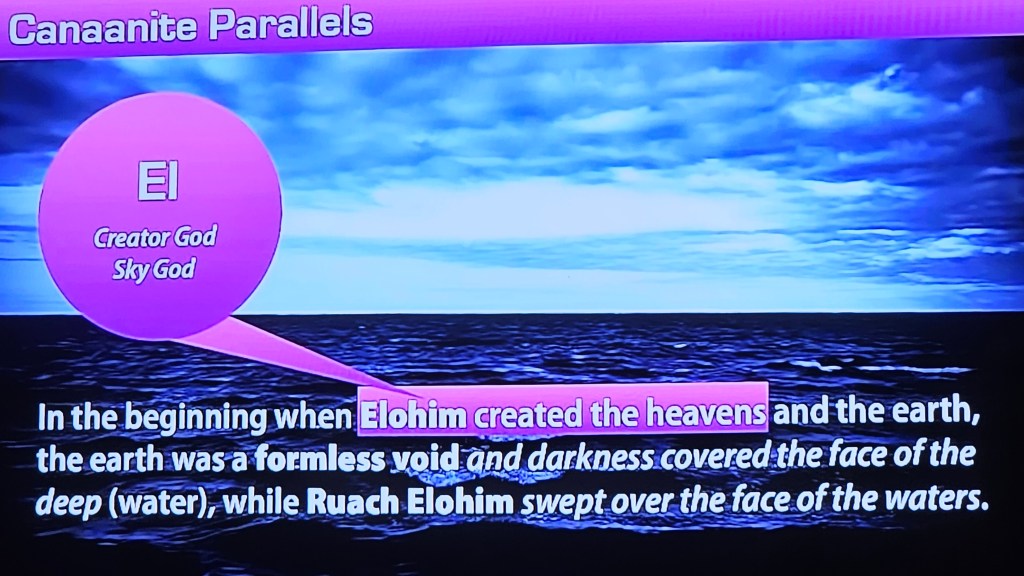
- The serpent that appears in the garden, which the Gods (Elohim is a plural noun, literally ‘the gods‘ and ‘assembly of the gods‘) fears will make mankind “as we are,” can be interpreted as the kundalini serpent. This serpent symbolizes the divine energy and wisdom coiled at the base of the spine. This concept is reflected in St. Paul’s statement that “we have this inheritance in earthen vessels“. Moses later taught the Israelites about the healing power of this serpent during their desert wanderings.
- Kundalini, represented by the serpent, appears in various ancient traditions and cultures as a force that awakens divine potential in individuals; a kind of ‘god maker‘. Despite initial reservations, the idea of humans becoming godlike is echoed in Christ’s words, “You are all gods, and children of the one most high” which he quoted from Psalm 82 in the Old Testament. This suggests that each individual has the inherent capacity, encoded in our DNA, so to speak -to become like (not the same, but like) our heavenly father.
Further in the narrative, after eating the fruit from the tree of the knowledge of good and evil, Adam and Eve are expelled from the Garden and is thrown into a world of toil and torment. They settle among other people (a paradox since they are supposed to be the first two humans) and eventually have three sons: Cain, Abel, and Seth.
From a yogic perspective, these three sons—Cain, Abel, and Seth—can be seen as symbolic representations of Ida, Pingala, and Sushumna, the three major nerve pathways running along the human spine:
- Cain: Represents Ida, which corresponds to the left channel in the yogic system. Ida is associated with the moon, silver, and active qualities.
- Abel: Represents Pingala, corresponding to the right channel. Pingala is associated with the sun, gold, and receptive qualities.
- Seth: Represents Sushumna, the central channel inside the spine itself. Sushumna is the most significant of the three and is associated with the path to spiritual awakening and enlightenment.
It’s worth noting that Seth is said to have had 33 sons and 24 daughters. This numerical symbolism may further relate to the human spine and body, as there are 33 vertebrae in the spinal column and 24 ribs in our torso. Additionally, within the human spine there are twelve nerve pathways which neatly aligns with the concept of the 12 disciples (or the much older 12 sons of El in Canaanite traditions), providing further connections between biblical narratives and yogic symbolism.
The murder of Abel at the hands of Cain, can further be interpreted as the worldly obstructing the spiritual, of Ida overriding Pingala in importance in the human being. The offshooting nerves immediately after Svadhistana being of special significance.
The mark of Cain being the bellybutton, the mark of having been thrown into a body of flesh.
In the biblical narrative of Golgotha, where Jesus is crucified alongside two thieves, there are symbolic interpretations that align with what I have described above:
- The Two Thieves: The two thieves accompanying Jesus can be seen as symbolic representations of Ida and Pingala, the two major nerve channels flanking the spine in the yogic system. These channels are associated with various qualities, but at the level of the head (Golgotha means “place of the skull” in Jewish) they clearly indicate psychological attributes.
- The Thief on the Left: The thief on Jesus’s left, who is constantly blaming others for his misfortune, can be symbolically linked to Eve, representing the tendency to look outside ourselves and blame external factors for our circumstances.
- The Thief on the Right: The more reasonable thief on Jesus’s right represents introspection and self-realization. This corresponds to the concept of the “new Adam” who recognizes personal responsibility for his actions and their consequences.
Jesus declares that he will only take the thief on his right with him to heaven, signifying a transition from the material world (and outer focus) to a purely spiritual existence and bliss of heaven. This aligns with the yogic understanding of spiritual transformation and enlightenment, where one transcends the limitations of the physical body.
Furthermore, Jesus’s ability to appear and vanish at will after his resurrection corresponds to the powers attributed to highly advanced yogis in both Buddhist and Hindu traditions.
I want to add an observation here. In Hindu temples it is customary to circle around the inner sanctum of a deity a prescribed number of times, which is called pradakshina. The rule here is that you always enter the loop from the left side of the deity, with the right side of your body facing the shrine at all times. The reason being that the deity helps strengthen the right nerve pathway along the spine – and also because the deity cant stand the sight of the left channel.
Secrets of the body
By interpreting the biblical narrative in this yogic light, the concept of inherited sin becomes resolved as karma, the consequences of one’s own actions that are carried in the body as karmic debt. This perspective provides a more profound understanding of the biblical teachings and their alignment with spiritual concepts from other traditions.
‘Debt’ is even a term St. Paul uses, that unless we change our ways we will ‘not get out until every debt has been paid in full‘.
The cryptic references to organs and anatomical parts in the Bible can be better understood through a yogic perspective, shedding light on passages such as the one from Jeremiah:
I the Lord search the heart and test the kidneys, to give every man according to his ways, according to the fruit of his deeds.
Jeremiah 17:10
The same biological reference is later echoed in revelation through Christ:
I know your kidneys! See, I have placed before you an open door that no one can shut.
Revelation 3:18
The yogic decoding of these motifs helps to demystify the passages and highlights its relevance to established spiritual traditions. It underscores the idea that a connection with a higher power is not external in nature, but rather intrinsic to our very bodies; waiting to be realized.
It also solves perhaps the most cryptic passage of them all, one that has puzzled theologians for centuries:
He that is wounded in the testicles, or hath his member cut off, shall not be admitted into the assembly of the lord
Old Testament, Deuteronomy 23:1
That quote is tantra, plain and simple. Semen is of utmost importance in transformative practices since it literally is the fuel the body uses to ignite the chakras; a bit like gasoline in my car parallel earlier. There is no other reason why a man would be prohibited from the rites due to physical damage.
This fire, the kunda (fire pit) of Svadhisthana, is also the root of the monstrous error the priests of Ba’al committed. They no doubt imagined that since the body recycles semen in the fire of the second chakra, that God wanted children to be burned in similar fashion. And these priests in their utter madness did the unthinkable, of throwing children into the fire of Moloch in northern Africa. This is what happens when the true meaning of symbolism is lost, and literalists are allowed to do as they please! Absolutely monstrous!
The challenge with passages like those I just quoted, is not just understanding what these things mean in their original, clearly psychosomatic context. But rather that we first have to peel back layers of ‘literalist conclusions‘ that theologians have insisted on through the centuries. In modern theology, there’s a tendency to replace terms like “kidneys” with metaphorical interpretations (such as acts or deeds), obscuring the original meaning.
By removing the word kidneys from the new testament, literalistic theology is in fact erasing an important esoteric marker, one that the original author’s without a doubt left there on purpose.
It appears to me, that to gain a deeper understanding of these passages (if not restore what was lost in the west), it is quite simply crucial to adopt a more comprehensive approach than what traditional theology allows. An approach that acknowledges the psychosomatic context that is clearly there, and that embraces the symbolism common to the yogic schools. Quite simply because India and Tibet is our only link to the ancient world that are still alive and operational. This approach allows us to explore the intricate metaphors and symbols that would otherwise remain absurd; if not outright incomprehensible.
The burning of karmic seeds
In the process of spiritual salvation, particularly in yogic practices, there exists a significant ritual known as Shaktipat. During Shaktipat, a yogi touches an individual’s head and transfers spirit, specifically the divine energy or shakti, into that person. In the Sanskrit tradition, the highest spirit is referred to as Maha (highest) Shakti (spirit), often equated with the descent of the Holy Spirit.
This initiation, which is simply the baptism ritual in Christianity, kickstarts a remarkable process referred to as ‘the burning of karmic seeds.’ It’s essential to understand that the human body acts as a repository for a portion of such karmic seeds (samskaras in Sanskrit), representing past transgressions or actions against other sentient beings. These karmic imprints are carried within us, influencing our lives in various ways, both physically and psychologically.
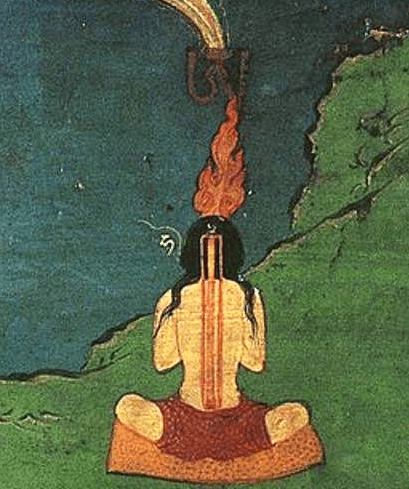
Through the psychosomatic fire of this process, the burning of these karmic seeds is not merely a metaphysical concept but manifests tangible physical and psychological changes within the individual.
In the new testament this is expressed somewhat cryptically as the murder of Rachel’s children:
A voice was heard in Rama, weeping and loud lamentation, Rachel weeping for her children; she refused to be comforted, because they are no more
Mathew 2:18
The concept of forgiveness and a fresh start, symbolized by having one’s slate wiped clean by God, holds profound significance in both Christianity and yogic traditions alike. Rituals such as washing the feet of the adept or the laying of hands on the head to transfer the Holy Spirit are deeply ingrained and universal in nature.
However, a shift occurred in the interpretation of these texts in the West after the disciplina arcani were prohibited from being taught in the fourth century. Following this prohibition, there has been a gradual decline in the understanding of the symbolism deployed by biblical literature, until their original meanings became utterly obscured at the dawn of the Victorian age. Notably, the interpretations that emerged after the loss of the disciplina arcani diverges significantly from what the early Christians had taught. Even concepts like reincarnation, which was an intrinsic part of early Christian doctrine and expounded upon by church fathers like Origenes, were removed.
This detachment from the original framework within which Christianity developed, a framework which had strong synergies to in Hindu doctrine, has had catastrophic and detrimental consequences for western society. It has led to a loss of connection with our own heritage, and dare I say rendered us strangers to our own selves.
For those so inclined, when this process of burning karma seeds starts, it feels like a flame dancing on top of your head. What in India is known as the grace of Devi. The grace of the goddess.
Devils and details
The concept of a devil, as we commonly understand it, is not present in the book of Genesis. It emerges later in the Hebrew Bible, particularly in references to Leviathan. Leviathan, a dragon-like creature, is mentioned in several books of the Hebrew Bible, including Psalms, the Book of Job, the Book of Isaiah, the Book of Amos, and the Book of Jonah. It is also referenced in the Book of Enoch.
The depiction of Leviathan in the Book of Job can be seen as a reflection of the older Lotan, a primeval monster defeated by the god Baal Hadad. Comparisons have been drawn between Leviathan and other mythological creatures, such as Tiamat in Mesopotamian mythology, defeated by Marduk, as well as dragon and world serpent narratives found in various traditions, such as Indra slaying Vitra and Thor slaying Jörmungandr.
In the context of understanding the human chakras as symbolic representations of inner psychosomatic processes, Leviathan is associated with the third chakra. This chakra is often depicted with a dragon or crocodile-like creature, symbolizing the ego and the intense dynamics of the subconscious, which can be thought of as a kind of jailor within our own psyche.
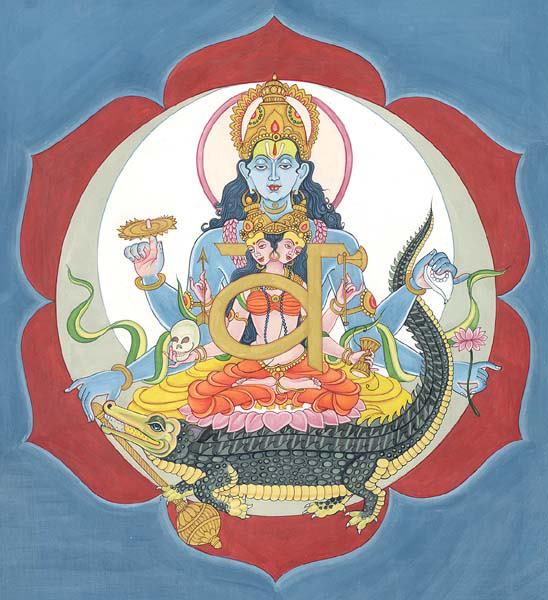
As the late professor of mythology and comparative religion, Joseph Campbell said in one of his lectures:
The dragon loves wealth and virgins. It cannot make use of either of them, but it likes to keep them locked up in his lair. These are the vitalities of your life that can be locked up by fear; your negative shadow.
Joseph Campbell, Myth video series, Sarah Lawrence university, NYC
In yogic terms, the process of addressing and taking control over the ego (in this case the fear that dualistic thinking produces), symbolized by the dragon or Leviathan in the third chakra, involves re-aligning or purifying this chakra. Purification, in this context, can be better understood as a reconfiguration. Each chakra can be thought of as a circuit board with multiple settings, and the setting you were born with defines the basis of your current personality.
Purification or reconfiguration of the third chakra is primarily achieved through the practice of chanting mantras. Additionally, guidance and assistance from a Guru, who serves as a spiritual teacher and intermediary between the individual and the divine (God, Guru, and self are considered one and the same in yogic terminology), are instrumental in navigating the inner landscape and effecting this transformation. This concept is similar to why Catholic priests are referred to as “father.”
The aim of this process is to redirect the flow of energy within this chakra so that it supports positive personality traits rather than negative ones.
The conclusion, regarding salvation and the means of salvation, can thus be concretized as such:
- Salvation can be understood as being spared from the consequences of our own negative actions, whether they occur in this life or in previous lifetimes. These consequences keep us bound to the cycle of life and death, including the concept of reincarnation (“if you eat of that tree, you shall surely die” – Genesis).
- Inherited sin can be equated with karma, which is carried within us in the form of karmic seeds. When the conditions are right, these seeds sprout and manifest as challenging situations, poor health, and unpleasant life experiences.
- Karma is primarily the result of ignorance, but it is also influenced by the improper alignment of our chakras (akin to impure churches, as described by St. Paul).
- The means of salvation involve the purification of our inner chakras through the grace of Shakti, which can be compared to the Holy Spirit in Christian terms. Additionally, various disciplines and techniques, such as mantras, directly impact our karma.
- Since each person has a unique chakra configuration, there is no one-size-fits-all method for salvation. This is why having a qualified guru, one who has mastered their own self, is crucial. Just as you would seek a skilled doctor to diagnose your ailment and prescribe the appropriate treatment, a guru guides individuals based on their unique spiritual needs and challenges.
Celestial archetypes
From the Victorian age onwards to the present day, the remnants of the disciplina arcani, or secret doctrine, have been scarce and fragmented. One example of such a fragment is the “zodiac man,” which survived as a novelty in American farmers’ almanacs, often providing dates for planting and harvesting crops. What remained within the secret societies appears to be a mix of alchemy, Greek and Jewish Kabbalah, gypsy-style fortune-telling, and a general consensus that the secret doctrine could be reduced to “scantily dressed astrology.” This reduction oversimplifies the depth and complexity of the secret teachings, akin to describing a modern cruise ship as simply “a really big canoe,” disregarding the intricate engineering and scientific knowledge required for its construction.
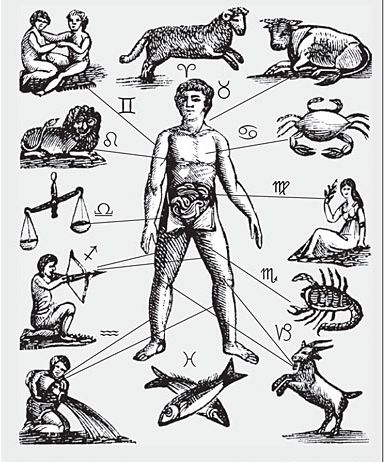
The significance of the zodiac man in Western spirituality is undeniable, and it could be the subject of an entire book due to its role as a key to understanding Western spirituality. Within the zodiac man, we can find archetypes that appear in the Gospels, as well as a map of human evolution through the ages. Although it may not be immediately apparent, a thorough understanding of these archetypes allows dedicated students to delve beneath the surface of various Greco-Roman cults, including Christianity. The symbols associated with the zodiac man are spread throughout the Temple of Luxor, a discovery first made by R.A. Schwaller de Lubicz in the late 1930s.
To illustrate how to approach this, let’s consider the Virgo archetype within its context, recognizing that it is a composite symbol, meaning it requires the understanding of two or more components to be fully recognized.
- As shown in the image above, Virgo is associated with the upper abdomen. However, the picture doesn’t fully capture the symbolism, as Virgo is also linked to a small region slightly above the solar plexus. In the myths and art of ancient cultures, the virgin archetype is often represented as either the daughter of the heart or the wife of the heart. The heart, in this context, represents the center of the soul, which, in Catholic terms, is symbolized by the sacred heart of Christ once it has been purified.
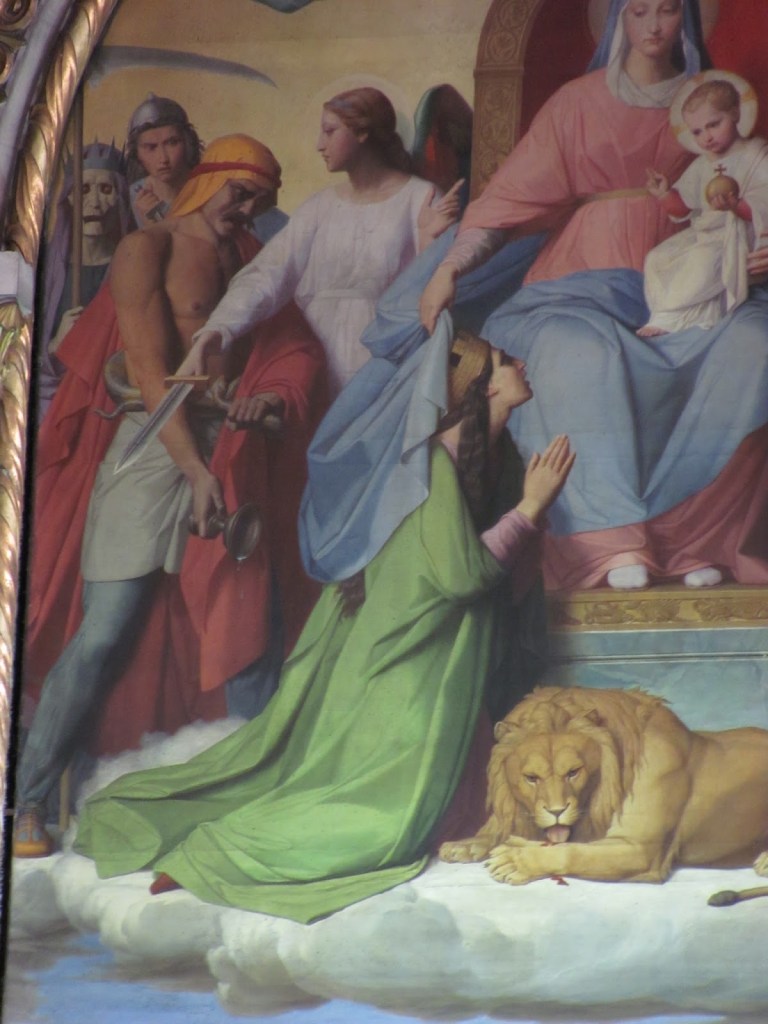
- During the Middle Ages, it was common to depict the Virgin Mary with a lion, often placed at her feet or nearby. The lion is associated with the solar plexus, which is considered the seat of courage and power in ancient mystic traditions. This connection between the Virgin Mary and the lion can be observed in ancient art from both the Western (e.g., Rome and Greece) and Middle Eastern traditions, with Roman armor frequently featuring a lion’s face at the solar plexus.
When people in the first century heard sayings like ‘born of a virgin,’ they understood it in a very different way from the modern Christian view. It had nothing to do with a human female magically giving birth without sexual intercourse, nor did it involve literal star-lore, except as symbolic markers. Instead, it was associated with a sacred psychosomatic transformation within the human body. This transformation led to the birth of a special kind of seed, a concept that modern medical science is unfamiliar with. This understanding is deeply rooted in ancient wisdom that can only be extracted at great difficulty.
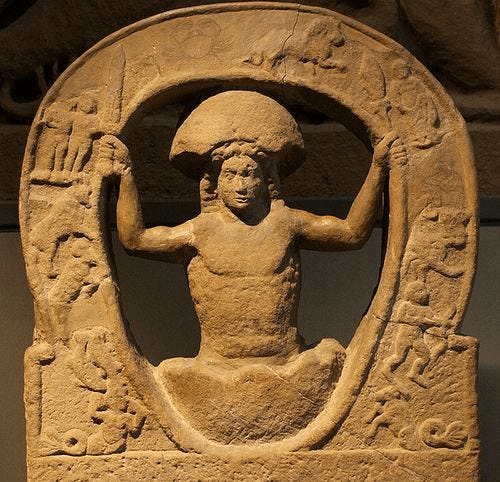
Combining the two aspects I’ve mentioned—the virgin and the lion—within the symbol of Virgo, and considering the historical depiction of the Virgin Mary with a lion during medieval times, we arrive at one of the most ancient and profound archetypes in human history. This archetype represents the mother goddess herself, a powerful and central figure in various cultures. In Hinduism, she is Durga, the force behind all the gods. In Christianity, she is Notre Dame, meaning “Our Lady.” This archetype embodies the divine feminine and carries deep spiritual significance.
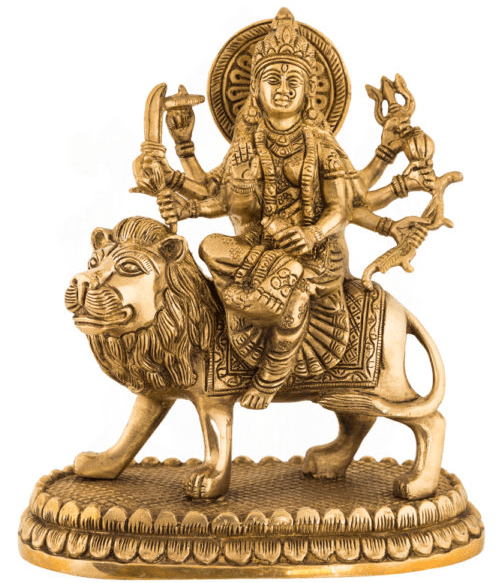
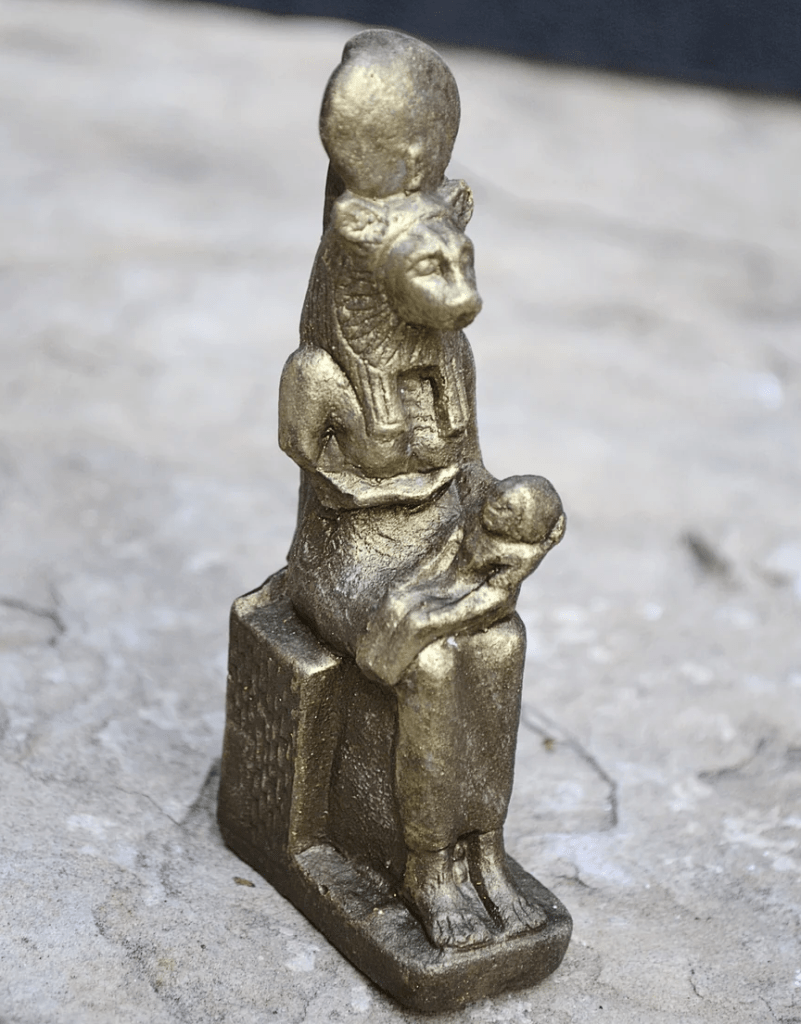
This symbol is undeniably one of the oldest known to humanity. In ancient Egypt, she was revered as Sekhmet, a fierce protector and the source of pharaonic power. The representation of Sekhmet with a sacred child on her lap is a direct correspondence linking several ancient religions neatly to Christianity.
It signifies earlier forms of the Virgin Mary, although portrayed in a format unfamiliar to modern Christians. How can we discern this connection with the Egyptian Sekhmet? It’s relatively straightforward. In ancient Egyptian iconography, deities were depicted with a special staff, and the height of this staff (and in some cases grip of the hand) indicated which part of the body the deity influenced or resided in (essentially, which chakra is associated with them).
Sekhmet’s staff is positioned directly between the heart and the solar plexus, providing us with three direct correspondences that underscore the identity of this archetype (and this is merely scratching the surface; there are additional layers to explore such as her association with the month of September, her connection to specific hours of the day, the architecture and structure of her sanctuaries, and more).
The key lesson from the symbolic deconstruction presented here is that the language used to convey these profound concepts is not rigid or confined to a single culture. It’s a symbolic language that transcends cultural boundaries, and once you grasp the fundamental symbolism, you’ll be able to recognize it across various traditions.
A fascinating aspect of this symbolism is that Durga is often referred to as ‘the goddess of no womb’ because her creative power is only manifested within you, in the womb of the heart (the yoni of the Shivalinga in the heart). She remains forever pure and virginal, known as Virgo Virgonis in Roman tradition.
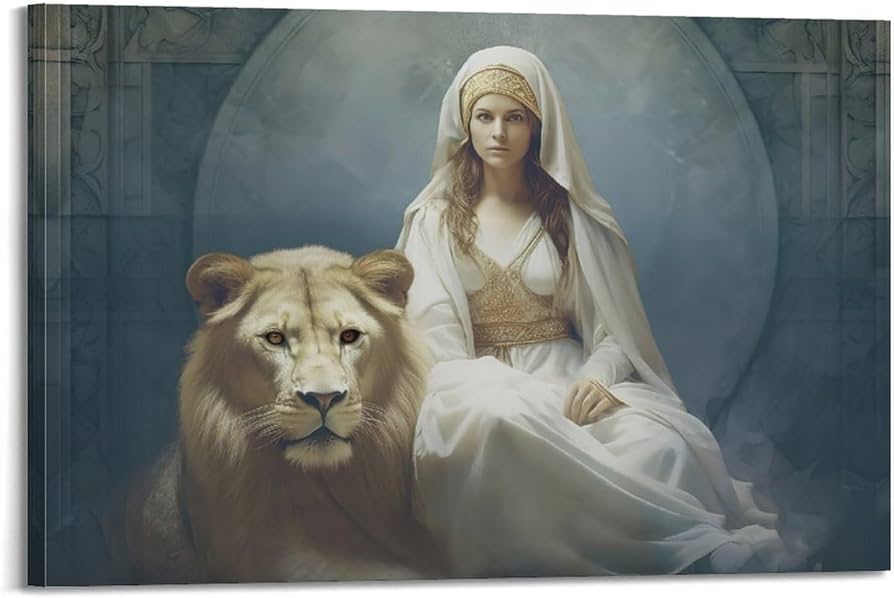
The inner birth that is described here has been known throughout human history, but has only been conveyed through art, architecture, hints and winks.
If we go back even further, we find it symbolized in the union of Ishtar and Ba’al through the ritual act of celibacy (which serves as a catalyst, as otherwise the sacred seed cannot form). These hints provide a glimpse of the profound transformations concealed within these ancient texts, for those who have the eyes to see them.
We are rigged for this experience through our own biology.
Celestial Ecology
As we delve into the realm of astrological markers, it’s crucial to emphasize that original astrology, as developed in ancient Egypt, Greece, and India, bears no resemblance to the trivial horoscopes found in today’s newspapers and women’s magazines. In fact, Egypt had strict laws against personal horoscopes, and Greece held personal astrology with contempt, drawing much of its astrological tradition from Egypt.
Original astrology, in its purest form, can be best characterized as the “study of the solar system as our extended ecosystem.” It appears more like an exploration of the natural world’s dynamics and cycles and their influence on human life. It viewed our solar system as a living organism (purusha), an intricate ecosystem, and a tangible manifestation of God the father, echoing the sentiments found in the Book of Acts.
For it is in him we live, breathe and have our existence
New testament, Acts 17:28
In our modern era, we typically delineate our ecosystem at the stratosphere level, considering the sun and the moon as mere extensions. The moon’s influence on ocean tides and the sun’s provision of heat and energy are the extent to which modern science is willing to accept external factors affecting life on Earth.
The ancient Egyptians, on the other hand, took a far more comprehensive approach. They conducted extensive studies of the heavens in relation to social events, seemingly spanning thousands of years. They could reasonably assert that the movements of specific planets correlated with distinct changes in human behavior. For instance, they associated Mars with war because its presence often led to heightened aggression in the population, while Saturn’s influence was linked to periods of suffering and stagnation. Conversely, Jupiter’s influence was correlated with social growth, increased optimism, and more peaceful living conditions.
However, the Egyptians didn’t stop at understanding how humans react to changes in the solar system. They were first and foremost a practical people. For a society deeply connected to nature, knowing the cycles of nature was of paramount importance. Egyptian temples and tombs are replete with information about these cycles, some covering time periods that modern archaeology is reluctant to explore. Importantly, these cycles also exist within us; obviously with shorter timeframes.
Here, we arrive at the second key: the understanding that the forces shaping the sacred landscape are, in essence, reflections of the solar system itself and the natural world that gave rise to us. The ancient axiom “as above, so below” encapsulates this idea—an insight resulting from thousands of years of meticulous study of the heavens, nature, and human behavior, as undertaken by the Egyptians.
This concept possesses a triple depth of meaning: we are miniature replicas of the solar system, the solar system is a physical embodiment of God (his chakras), and beneath the physical reality lies a realm of mind and consciousness. In Hindu terminology, specifically within Saivism, this is exemplified in the three worlds of Shiva, where all changes in the material realm are mere reflections of changes in underlying realities.
In Saivism we find reality defined as having three layers, each which are inhabited by living creatures. These are:
- Bhu loka (material reality)
- Manas loka (psychological reality)
- Deva loka (divine reality)
To the ancients, the study of humanity was inseparable from the study of nature. We are products of the cosmos, and nature’s reflection can be seen in us. It is fascinating to note that these ancient ideas align more closely with modern physics than with rampant atheism or reductionist views of evolution.
In the early Christian belief system, heaven was not initially an abstract concept but rather something visible every night with the naked eye. It was only during the Age of Enlightenment, with the invention of telescopes, that heaven began to be seen as abstract. By then, the understanding that material bodies were manifestations of underlying spiritual realities had largely faded from public consciousness. Consequently, planets were reduced to being perceived as mere lumps of rock, a viewpoint that persists to this day.
To conclude this train of thought, although I could delve into numerous astrological correspondences, it’s important to emphasize that the esoteric doctrine was never solely based on star-lore. Astrology is significant because the solar system serves as the machinery that enables reincarnation—a parallel might be drawn to the solar system being the computer running the virtual reality simulation in which we find ourselves. However, I don’t find convincing evidence that the underlying esoteric doctrine was merely astrology dressed up as gods.
As I hope I’ve made clear in this chapter, the disciplina arcani seem firmly rooted in the secrets of the human body.
The Hindu connection
Up to this point I’ve primarily presented circumstantial evidence, except for the comparison between Brahma and Abraham. To fully comprehend the extent of the symbolism within Christianity, it was necessary to deconstruct some of its motifs. I know this will be upsetting to some people, but there was simply no other way.
I will conclude this chapter by providing a more direct comparison, which I hope will help settle the debate once and for all. Let’s start with what is considered an archetypal Christian statement, the opening scene of the gospel according to John:
In the beginning was the Word, and the Word was with God, and the Word was God
Gospel of John 1.1
This is not a Christian statement, but a quote from Hindu literature. A statement which appears there in several ancient Hindu texts. The original reads as such:
Prajapati vak agre asset
Krishna Yajurveda, Kathaka Samhita, 12.5, 27.1;
Tasya vak dvitiya aseet
Vak vai parama Brahman
Krishna Yajurveda, Kathakapisthala Samhita, 42.1;
Jaiminiya Brahmana II, Samaveda, 2244
Which can be translated as such:
In the beginning was Prajapati (Brahman)
With whom was the Word;
And the Word was verily Brahman.
Hindu Crucifixions
You might expect the crucifixion to be a pivotal Christian concept, but it is actually one of the oldest ideas in existence, first found in the Rigveda, the oldest religious text known to man:
They fixed prajapati in space by crucifying him on a four-armed cross. They tied his radiant bright form up to a vertical pole and made him the sacrificial being to form out of him the 7 planes of creation. Thus, from his flesh and blood they brought out the quintessence of the beings of the entire universe.
The Rigveda, Purusha Suktha
When Prajapati is asked who he is, he replied as such:
I am the son of God, born of a virgin
Bhavisya Purana
(isa-putram mam viddhi kumari-garbha sambhavam)
It is no doubt for this reason St Augustine wrote:
That which is known as the Christian religion existed among the ancients, and never did not exist
To reiterate what I wrote earlier on the subject: Hindu doctrine is called Sanatana Dharma, which translates to the “eternal doctrine.” What Augustine is alluding to here is (imho) the Disciplina Arcani, the understanding that there exists an underlying framework (e.g. chakras et-al) on which all religion is based on.
Arius and the eternal wisdom
The goddess of wisdom was important to early Christians, especially the Arians. A Christianity that sadly lost to the Catholic, literalist nonsense and was eradicated.
In proverbs 2 Sophia speaks: She was with God before creation, and she was the master worker through whom God created the world.
Arius theology on this point was correct, Sophia (a personification of God’s wisdom that appear in multiple places in the bible, and especially in the gnostic texts 3) was indeed with the creator when he made the world -because Brahma the creator god is married to Sarasvati; the Hindu goddess of knowledge and wisdom.
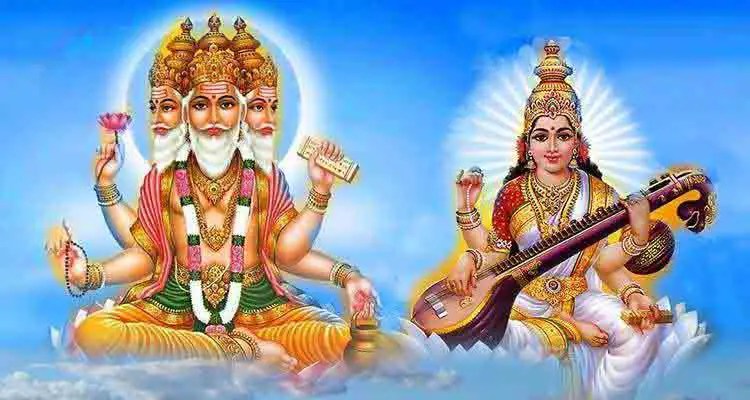
The amount of scholarly nonsense theologians has produced over the centuries for this simple thing is unbelievable. To be blunt: They were all wrong. Thousands of books trying to make it all fit the truly heretical doctrine of literalism. And it turned out to be completely wrong.
They actually killed people over this, imagine that.
The rapture of the 44.000
The concept of “rapture” in Christian circles, particularly within Protestantism, can be understood in a different light when viewed through the lens of yogic sciences. Christians believe that a select group of 44,000 people, virgins to be precise, will be miraculously transported to heaven as the end of the world approaches. This belief can find its origins in yogic teachings and have somehow been perverted by literalism.
In yogic philosophy, the seventh and highest chakra, located at the crown of the head, is said to contain 44,000 dormant nerve pathways known as nadis in Sanskrit. When the mustard seed produced by Virgo completes its journey through the body and reaches the head (symbolized as Golgotha or the “place of the skull”), these 44,000 pathways become active.
The activation of these pathways results in an elevated state of consciousness, a form of super-consciousness that transcends the ordinary human capacity. This heightened state of awareness may be perceived as godlike, as it grants insight into aspects of reality that are typically hidden from our ordinary senses.
What I just described is gnosis, a concept which is very much alive in the eastern orthodox church, which has retained many of the concepts that the western heretical church eradicated.
Conclusions
I want to emphasize that my intention in presenting these insights is not to undermine or destroy Christianity, but rather to illuminate its original esoteric core. The early form of Christianity, before it was manipulated by Rome, possessed a profound mystical beauty.
I have personally experienced many of the spiritual principles I’ve outlined in this book on my own body. The gods (angels in the Christian framework) are very real, that I can personally stand as a witness to. The sacred seed is likewise real, I have experienced that myself. The mother goddess, which lives in the house of virgo, is likewise a very real power. As is the holy spirit, mahashakti.
The emphasis on literalism by the church has often brought out the worst in people, but the mystical Christ, the bull of the ancient world, now he brings out the best in humanity. Whether you call this seed Shiva, Krishna, or Christ, the journey ultimately demands the same of the individual.
It is disheartening to see how few people today genuinely go within and seek to find God; and Christianity, as a result, is practically extinct in northern Europe.
It is especially sorrowful considering the monumental potential that lies dormant in those text, wasted in the hands of those who remain unaware of their true nature.
Reference material
- The anatomy of a church, John MacArthur, ISBN 9780802451323 ↩︎The Temple of Man, R. A. Schwaller de Lubicz, ISBN 9780892815708 ↩︎Topographical and Anatomical Aspects of the Gothic Cathedral, Journal of Aesthetics and Criticism 20, no. 1 (1963): 3-23. ↩︎The Hindu Temple, Stella Kramrisch, ISBN 9788120802223 ↩︎The Buddha, ChaChakkasutta, Majjhima Nikāya 148 ↩︎Tibetan tantric practices, Wikipedia article ↩︎Gautama Buddha, Nagara Sutta, The city ↩︎ Georg Dehio, Gustav von Bezold: Kirchliche Baukunst des Abendlandes. Stuttgart: Verlag der Cotta’schen Buchhandlung 1887–1901 ↩︎ The stories of Ganesha, Shubha Vilas, ISBN 9789354400865f ↩︎Bhavisya Purana 19:23, Rasbihari Lal & Sons, ASIN B072VY4LM5 ↩︎Introduction to Kaballa: Based on Rabbi Chaim Moshe Luzzatto’s; Kalach Pitchei Chochma, ASIN: B000EAP998 ↩︎Whitty, John. “Rethinking the Disciplina Arcani.” Studia Patristica. Vol. CIV – Papers presented at the Eighteenth International Conference on Patristic Studies held in Oxford 2019 (2021): 85–92. Web. ↩︎The Jesus Mysteries, Timothy Freke and Peter Gandy, ASIN: B07FPT9PKM ↩︎Chair of St.Peter, St. Peters Basilica ↩︎Chair of St.Peter, St. Peters Basilica ↩︎St. Augustine, Anna Kingsford: Her Life, Letters, Diary and Work. Cambridge Library Collection. ISBN: 9781108072748 ↩︎Church father Irenaeus, fragments of lost works, section 17 ↩︎Church father Irenaeus, fragments of lost works, section 15 ↩︎MukhaLingam, Wikipedia ↩︎


Leave a Reply