Let us look at perhaps one of his most famous poetic texts regarding the goddess, an excerpt from the Song of Solomon. Literal readers are oblivious to what is actually being expressed here and believe this is about carnal love between him and a woman. I beg to differ.
Your body is a chalice, wine-filled. Your skin is silken and tawny like a field of wheat touched by the breeze.
Song of Solomon 7:2-12
Your breasts are like fawns, twins of a gazelle.
Your neck is carved ivory, curved and slender. Your eyes are wells of light, deep with mystery. Quintessentially feminine! Your profile turns all heads, commanding attention.
The feelings I get when I see the high mountain ranges – stirrings of desire, longings for the heights – Remind me of you, and I’m spoiled for anyone else!
Your beauty, within and without, is absolute, dear lover, close companion.
You are tall and supple, like the palm tree, and your full breasts are like sweet clusters of dates.
I say, “I’m going to climb that palm tree! I’m going to caress its fruit!” Oh yes! Your breasts will be clusters of sweet fruit to me
Let us start by deconstructing the text into key elements:
- White tawny skin
- A neck of ivory
- The mountain range
- Gazelles
- Breasts as clusters of dates
- Palm tree
It should be fairly obvious who he is referring to here, and it’s absolutely not a human mistress. It is Artemis.
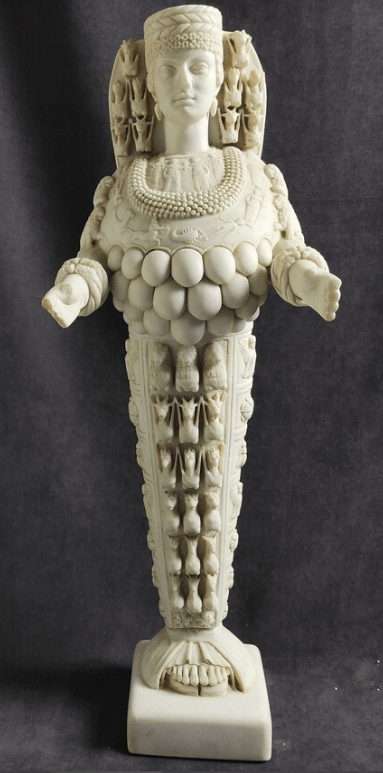
Solomon is in fact addressing the great mother, Shakti, in the form of Artemis. The lady of the hunt, who in the Greek mysteries roams the mountain range at the foot of mount Olympus (the skull). People might want to remember that Golgotha likewise means “place of the skull” before they start throwing superlatives around.
She is “the land of milk and honey”. Her sacred seal is the honey bee, and her rite included libations of milk and honey. She is depicted with a generous number of breasts because she is ‘the great provider’.
Observant students will notice that her breasts are without nipples, because they are in fact palm dates, which was her symbol in the middle east in earliest times.
Biological house
As always, deities symbolizes not just a separate, conscious being -but also a part of human anatomy. You will find her as the top of the brainstem, where all signals and chemicals for the body is produced, including the soma. She literally holds the footstool of God’s house – the pineal gland.
So “the land of milk and honey” is not a location on a map, but rather much, much closer. Like Christ, Buddha, Krishna, Rama and Shiva all say: the kingdom of heaven is within us. Literally and figuratively.
The gods are both inside us, and outside us. The full glory of nature was invested in mankind, and each deity gave us a piece each, which is their house in us. Thus it is said that ‘in my father’s house there are many dwelling places‘.
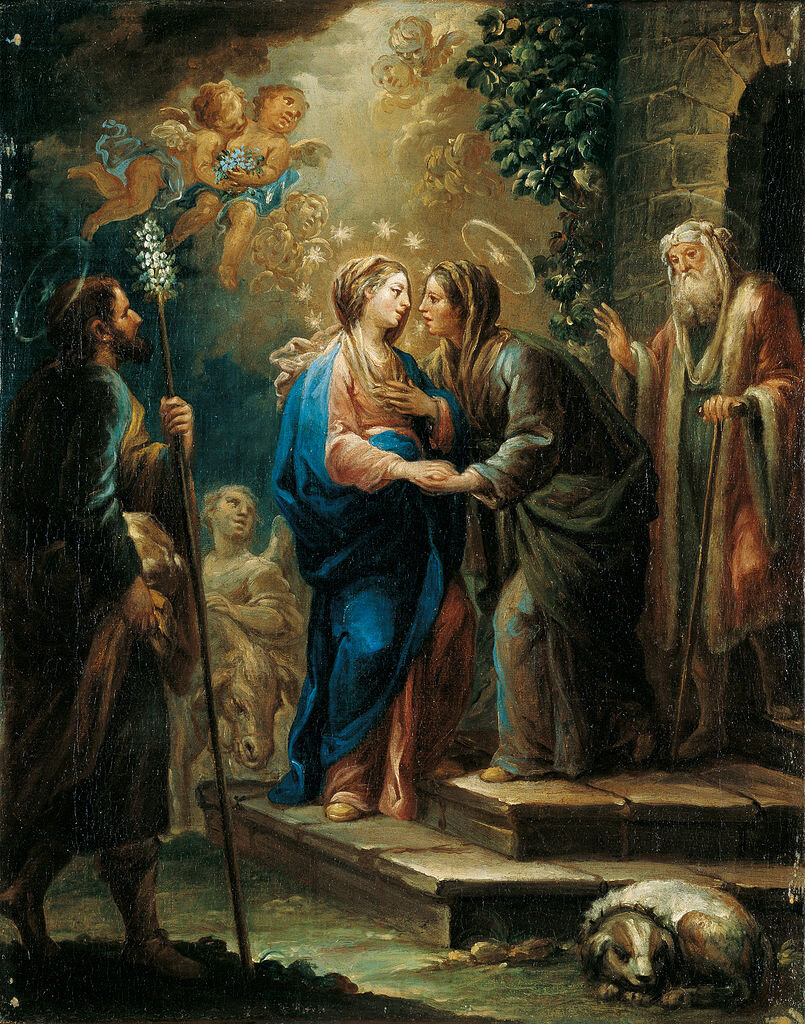
Her Christian name is Elizabeth, which Virgo (Mary) visits when Christ, the sacred seed, is born.


Leave a Reply